

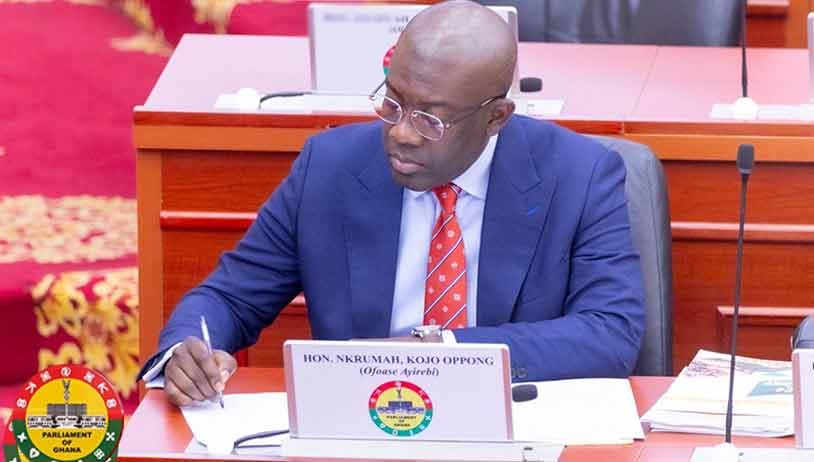
The Member of Parliament for Ofoase-Ayirebi, Kojo Oppong Nkrumah, is set to hand over two newly completed six-unit classroom blocks to communities in his constituency on Tuesday, Dec. 16, 2025, as part of efforts to improve basic education infrastructure.
The facilities, located at Anyinase Presbyterian Basic School and Bontodiase Presbyterian Basic School, are expected to provide pupils with safer and more conducive learning environments. The handing-over ceremonies will take place at 8 a.m. at Anyinase and 9 a.m. at Bontodiase.
In a statement, Oppong Nkrumah expressed the hope that the new classrooms would enhance teaching and learning outcomes for children in the two communities. He noted that the projects reflect his commitment to supporting education as a key pillar of development within the Ofoase-Ayirebi Constituency.
“These classrooms are intended to give our children the environment they need to study, grow and achieve their full potential,” he said.
The lawmaker disclosed that three additional classroom block projects are currently under construction in other parts of the constituency, underscoring ongoing investment in educational infrastructure.
The projects were completed under the leadership of Oppong Nkrumah and form part of broader constituency-level interventions aimed at addressing infrastructure gaps in basic schools. Local education authorities have welcomed the initiative, describing it as a timely boost to schools facing space constraints.
Traditional authorities, opinion leaders, teachers, students and other stakeholders have been invited to attend the ceremonies, which are expected to draw community participation and highlight the importance of education development.
Oppong Nkrumah also encouraged individuals and organizations interested in supporting education initiatives in the constituency to reach out through his office on call or WhatsApp 0244-616215.
The Ofoase-Ayirebi Constituency has in recent years prioritized school infrastructure as a means of improving access to quality education, particularly in rural communities where overcrowding and inadequate facilities remain challenges.