
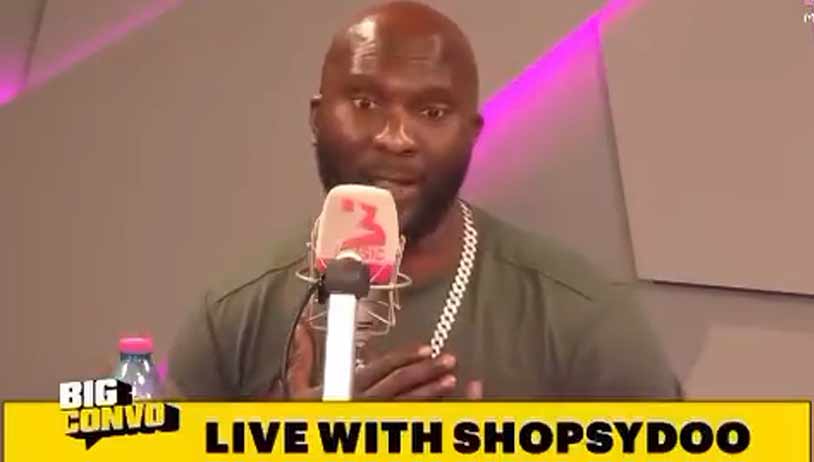
Nigerian media personality Shopsydoo has sparked renewed debate about recognition, competition and legacy in Ghana’s music industry, arguing that award-winning Afro Dancehall star Stonebwoy is not appreciated to the extent his achievements warrant.
Speaking during a wide-ranging discussion at the studios of 3Music, Shopsydoo said Stonebwoy’s sustained international success, consistency and cultural representation are often acknowledged only superficially at home. “Stonebwoy never gets the credit he deserves,” he said, describing the artiste as one of Africa’s strongest performers and among Ghana’s most consistent musical exports in recent years.
Shopsydoo pointed to Stonebwoy’s touring record across Europe and the Caribbean, noting performances from London to Germany, alongside what he described as an unmatched ability to fly the Ghanaian flag globally. “It’s not easy to do what he’s doing,” he said, adding that casual praise often fails to reflect the scale of the work involved.
The conversation widened as panelists examined why overwhelming success can sometimes generate resistance rather than celebration. One presenter likened the industry to long-standing rivalries such as Mercedes and BMW, arguing that audiences have become accustomed to competition and may resist fully embracing dominance for fear it disrupts the narrative. “Even if Stonebwoy brings the sun in his hand, it becomes harder for people to accept,” the presenter said.
Shopsydoo traced Stonebwoy’s journey from humble beginnings to international acclaim, citing his rise from the streets, mentorship under Samini, personal setbacks, academic achievements, family life and philanthropic work. He noted that Stonebwoy earned his first degree, completed a master’s programme, launched a foundation and still filled a stadium in the same year. “Stonebwoy has not had an off moment for six years,” he said. “There is no other artiste you can show me with that consistency.”
Another strand of the debate focused on media exposure. Shopsydoo argued that Stonebwoy stands out as one of the few Ghanaian pop artistes to feature regularly on major global media platforms, delivering articulate interviews that project Ghana positively. While some panelists agreed, others contended that Stonebwoy is widely appreciated locally, particularly following the release of his Fifth Dimension album and its extensive promotional tour.
That tour, contributors noted, marked one of the most aggressive international marketing campaigns by a Ghanaian artiste, generating conversations across social media and earning recognition for its scale. Still, Shopsydoo insisted the response would have been louder if the same feats were achieved by a Nigerian act. He cited Stonebwoy’s promotional appearance at Ajax Amsterdam’s stadium and collaborations linked to European football as examples he felt were underplayed at home.
The discussion also addressed the role of relationships and branding. Shopsydoo rejected the idea that Stonebwoy’s access to elite spaces was purely relational, arguing that global brands assess alignment before opening doors. “Those relationships don’t meet you in Accra,” he said. “They meet you where your status has taken you.”
Attention then turned to how negativity can overshadow achievement. Shopsydoo cited a recent festival appearance by Nigerian star Tiwa Savage, where a brief moment of frustration dominated online narratives despite a strong performance. He said similar patterns affect Stonebwoy, with isolated comments eclipsing sustained excellence.
Panelists agreed that public relations was not the central issue, with Shopsydoo saying Stonebwoy’s team had executed its role effectively. Instead, the conversation shifted towards structural shortcomings, questioning whether Ghana has institutionalised mechanisms to preserve and amplify artistic legacy.
Drawing comparisons with global music culture, Shopsydoo argued that earlier Ghanaian superstars struggled to transition fully into the digital era, weakening intergenerational connection. He contrasted this with how international industries cement legacy through major platforms and cultural moments, urging Ghanaian stakeholders to do more.
Despite differing views, the panel converged on a shared conclusion. Stonebwoy, they agreed, is respected and recognised, but not to the depth his body of work demands. As Shopsydoo put it, “We are not saying Stonebwoy is not appreciated. We are saying he is not appreciated as much as he deserves.”
Watch Video: