
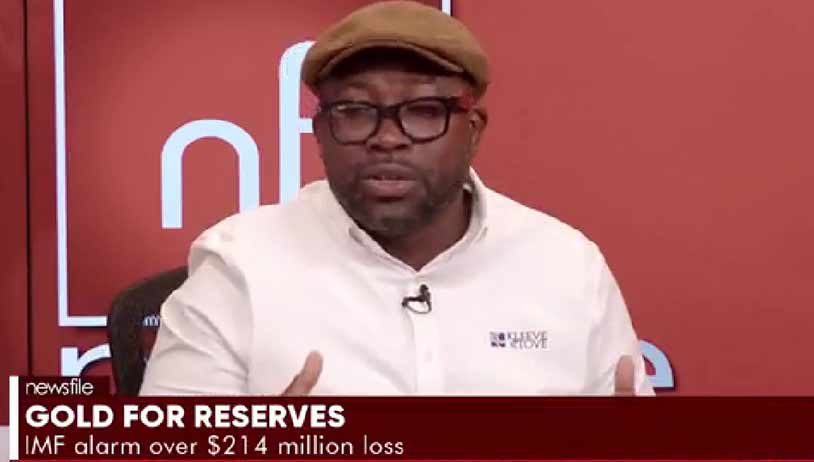
Business leader and policy advocate Senyo Hosi has called for constructive criticism and broader national consensus around Ghana’s GoldBod and domestic gold purchase programmes, arguing that while trading losses exist, the overall policy has delivered net economic benefits by shoring up foreign exchange inflows, stabilising the cedi and curbing inflation.
Speaking on Joy News’ Newsfile during an extended panel discussion, Hosi said advocacy from civil society groups, the parliamentary minority and analysts such as IMANI’s Bright Simons was healthy for democracy, as it had forced greater transparency and explanation from public institutions.
“It is good for accountability,” Hosi said. “It brought visibility to the issues and brought people here today to explain what is happening.”
However, he cautioned against misrepresentation of facts, stressing the need for accuracy even in fierce public debate. Hosi said he entered the discussion after reviewing IMF commentary and holding extensive conversations with GoldBod Chief Executive Sammy Gyamfi, IMF-linked contacts and civil society actors.
On the central issue of IMF-flagged trading losses under the gold-for-reserves framework, Hosi said such losses exist but must be properly contextualised. He argued that they do not accrue to the GoldBod as an institution, which he described as a monetary-policy-support entity rather than a profit-making body.
“The GoldBod hasn’t made losses,” Hosi said. “The structure of the programme means there is no loss that accrues to it directly, but the question is what those trading losses imply for policy.”
Hosi said what drew him to support the GoldBod concept was its potential to close long-standing gaps in Ghana’s gold trade, particularly the large volumes of artisanal and small-scale mining (ASM) gold that leave the country without corresponding foreign exchange inflows. Citing reports by SwissAid and OECD-linked data, he said an estimated 229 tonnes of gold over several years — averaging about 45 tonnes annually — had been unaccounted for, largely ending up in markets such as the United Arab Emirates.
“At today’s prices, that is over six billion dollars,” Hosi said. “That is double what we went to the IMF for.”
He argued that these leakages had weakened Ghana’s balance of payments, eroded reserves and put pressure on the currency, contributing to the crisis that pushed the country towards IMF support when import cover fell to critically low levels.
According to Hosi, the domestic gold purchase programme (DGPP), which later evolved into the GoldBod framework, was designed to claw back these lost volumes and ensure that gold exports translated into real FX inflows. He credited the idea to earlier policy thinking under the previous government, saying the current administration had refined and optimised it.
“What the current government has done is to perfect the idea and clean up the loose ends,” he said.
Hosi rejected comparisons between gold and cocoa policy structures, saying the risks of smuggling and capital flight in gold were fundamentally different and justified a stronger state intervention. He acknowledged, however, that the system still needed tighter track-and-trace mechanisms, improved accountability and responsible sourcing standards.
On the IMF’s concerns, Hosi said the Fund recognised the success of the DGPP in boosting reserves and meeting net international reserve targets but was uncomfortable with the associated costs sitting on the Bank of Ghana’s books. He agreed that some form of fiscal burden-sharing could be appropriate.
He noted that central banks routinely incur trading or net interest losses through open market operations as part of inflation control, arguing that such losses are an accepted cost of monetary policy. Hosi said recent currency stability had played a major role in reducing inflation, which he described as the Bank of Ghana’s primary mandate.
Addressing claims that debt restructuring and IMF programmes were the main drivers of cedi stability, Hosi argued these factors were already priced into markets and could be considered “sunk” in policy terms. He said the key change in 2025 was the improved capture of FX from gold exports, amplified by higher global gold prices.
“The IMF itself says the domestic gold purchase programme has been the key source of inflows,” he said, adding that Ghana had consistently outperformed reserve targets partly for that reason.
While defending the policy, Hosi said costs must still be reduced. He questioned why export discounts were previously as high as 2.25 per cent when market norms were closer to 1–2 per cent, noting recent progress in cutting them to about 1.1 per cent.
In closing, Hosi urged Ghanaians to see the GoldBod as a unifying national policy rather than a partisan issue. He called for constructive criticism to help refine the model, arguing that the fiscal savings generated by currency stability far outweighed the headline trading losses cited by critics.
“Let’s criticise, but let’s do it constructively,” he said. “This is a policy that should bring Ghana together, not divide us.”