
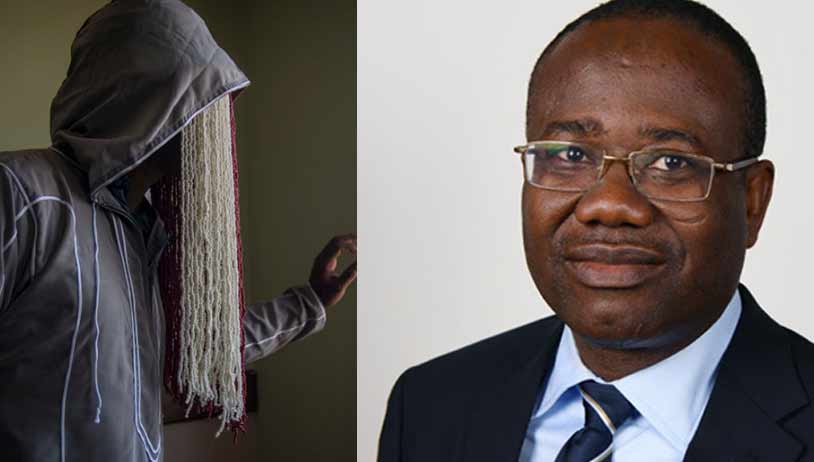
Former Ghana Football Association (GFA) president Kwesi Nyantakyi has broken his silence on the long-running fallout from the “Number 12” documentary, insisting he was framed and maintaining that the allegations levelled against him were never tested in court because the accuser refused to testify.
In an exclusive interview, Nyantakyi said he bears no personal grudge against investigative journalist Anas Aremeyaw Anas, whose 2018 undercover film alleged widespread corruption in Ghanaian football and led to Nyantakyi’s resignation. Instead, he said, he blames himself for engaging intermediaries who later became central to the scandal.
“I don’t think about him. I hold nothing against him. I blame myself,” Nyantakyi said. “If I didn’t entertain his people, this would not have happened.”
Nyantakyi rejected claims that Anas personally investigated or met him, saying he never encountered the journalist. He likened the method used to what he described as remote attribution of blame, arguing that responsibility was asserted without direct engagement. “He claims he did that work on me. I never met him,” he said.
Central to Nyantakyi’s argument is his contention that the allegations collapsed under legal scrutiny. He said the state prosecuted him for corruption — an offence applicable to public office holders — despite his insistence that the GFA is a private entity limited by guarantee, not a public office created by statute or the constitution.
For five years, Nyantakyi said, the state attempted to compel Anas to testify. According to Nyantakyi, the matter escalated to the Supreme Court, which ruled that the rights of an accused person must be balanced against those of an accuser, and that a witness could not conceal their identity while giving evidence.
“You cannot cover your face and give evidence against a person,” Nyantakyi said. “This is not a kangaroo court. The court of law exists to test evidence through cross-examination.”
Nyantakyi argued that the refusal to testify undermined the credibility of the allegations. “If he believed in what he gathered, he would have come to court,” he said, adding that disclosures required in criminal proceedings were never produced. “Not a single receipt was brought to show he funded my trips or paid me a bribe. Invoices are not receipts.”
Addressing claims that he received bribes, Nyantakyi acknowledged giving money to individuals he described as intermediaries, saying the payments were made in instalments after he was approached by a university lecturer he did not previously know. He said the sum discussed publicly — $150,000 — was distorted, and that the context of the payments has been misrepresented.
“I regret meeting them,” he said. “If I had the opportunity again, I would not.”
Nyantakyi also forcefully denied an allegation widely circulated after the documentary — that he claimed to have the president “in his pocket”. He challenged journalists to produce evidence of such a statement. “I never said that anywhere,” he said. “Prove it.”
Beyond the legal arguments, Nyantakyi spoke emotionally about the personal toll of the scandal, describing what he called irreparable damage to his reputation, family life and professional prospects. He said he never watched the documentary and still has not done so.
The most painful moment, he said, came from his then nine-year-old daughter, who asked him whether it was true he was a thief after hearing reports on the radio. “Imagine that question from your own daughter,” he said. “The damage is irreparable.”
Nyantakyi said the scandal led to the loss of multiple opportunities, some of which he declined to detail publicly. He cited what he described as a condescending shift in how people treated him and said his aura of respectability was shattered.
He also revealed that his United States visa was revoked following the documentary. According to Nyantakyi, the US Embassy in Accra told him the decision was based on footage alleging bribery. He said the visa has not been restored and that he has not travelled to the United States since. He said he is able to travel elsewhere.
Nyantakyi accused Anas of taking the matter beyond journalism into what he characterised as personal actions, including writing to foreign missions. “If you fight corruption and expose a person, you leave it and move on,” he said. “To go beyond that is something personal.”
Despite his anger at the consequences, Nyantakyi said he leaves judgment to God and harbours no desire for retribution. “If there is a day of judgment, it will be interesting for us all,” he said.
Reflecting on his life after football administration, Nyantakyi said the experience has changed him. A trained lawyer, he noted that many of his classmates are senior judges and leading legal practitioners, and that his years in football came at a professional cost. Still, he said the ordeal has strengthened him.
“Once in a while you have to live through some of these life experiences,” he said. “It builds you. I think I’m a better person now.”
Nyantakyi concluded by reiterating that setting someone up does not constitute justice. “Crime doesn’t work like that in any jurisdiction,” he said. “You don’t set somebody up in good faith and then say you have caught them.”