
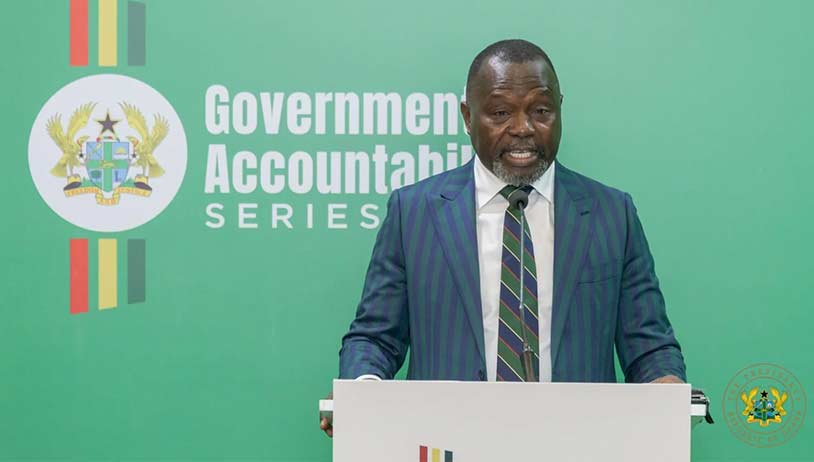
Attorney General and Minister for Justice Dominic Ayine has disclosed that the detention of former finance minister Ken Ofori-Atta in the United States follows the revocation of his visa and ongoing investigations involving Ghanaian and foreign authorities, insisting the matter goes beyond routine immigration enforcement.
Speaking in an exclusive interview on Joy News’ Newsfile, Mr Ayine said he began investigating Mr Ofori-Atta immediately upon assuming office, although he initially chose not to make the process public. He said the probe involves collaboration with foreign investigators tracking alleged offshore financial dealings, alongside parallel investigations being conducted in Ghana.
“These investigations are inconclusive as we speak. We have not come to any conclusion,” Mr Ayine said, emphasising that the case is distinct from the SML matter being handled by the Office of the Special Prosecutor (OSP). He described the issues surrounding Mr Ofori-Atta as “totally different” and potentially “mind-blowing,” but declined to provide details, citing the sensitivity of the investigations.
The Attorney General said he began working with American authorities on the case long before the OSP made any public announcement, and rejected claims that Mr Ofori-Atta’s difficulties stemmed simply from overstaying his visa.
“I want Ghanaians to know that he just didn’t overstay his visa. The visa was actually revoked,” Mr Ayine said.
According to him, the US State Department revoked Mr Ofori-Atta’s visa in July 2024 and granted him until November 29, 2024, to leave the country. Mr Ayine said Mr Ofori-Atta failed to comply with that directive.
“He did not, and that is how come they decided they were going to pursue him and arrest him,” he said.
Mr Ayine said the former minister was initially scheduled to be arrested on January 4, 2026, but was eventually apprehended on Tuesday, January 6, in the Virginia area, before being taken into custody by US immigration authorities.
Pressed by Newsfile host Samson Lardy Anyenini on whether the case was essentially an immigration issue, Mr Ayine insisted it was not.
“It’s not exactly about immigration,” he said, stressing that the revocation of the visa resulted in Mr Ofori-Atta losing his lawful immigration status in the United States.
When asked whether the visa had expired, Mr Ayine was categorical. “No, it was revoked. I am telling you this on authority,” he said, adding that he had held meetings with American authorities only days before the interview.
The Attorney General dismissed assertions by some lawyers in Ghana that the developments amounted to a standard immigration process. He said such arguments sought to downplay the seriousness of the matter.
“They want to give it that twist to make it look like there is nothing wrong,” Mr Ayine said.
He acknowledged that the formal extradition request submitted by Ghana relates to matters being pursued by the OSP, including the SML case, but stressed that his engagement with US authorities on Mr Ofori-Atta predates that process.
Asked directly whether the visa revocation was connected to the investigations he initiated, Mr Ayine declined to elaborate, saying discussions with American authorities were held in confidence. However, he confirmed that the revocation was not arbitrary.
“Something,” he said. “I wouldn’t want to give any details, but this is something that I can publicly confirm that the visa was revoked.”
On the extradition process, Mr Ayine explained that Ghana does not typically dispatch its own lawyers to prosecute cases in foreign courts. Instead, extradition proceedings are handled by the judicial system of the requested country, with the requesting state providing legal representation through formal channels.
“Normally, we don’t send our lawyers,” he said. “We are represented because we make the request to the American authorities.”
He likened the process to how Ghana handles extradition requests from other countries, noting that his office, often led by his deputy, Justice Srem-Sai, represents foreign states before Ghanaian courts when necessary.
“When they persuade the judge, the judge grants the extradition request and then we extradite the person. It is going to be the same,” he said.
Mr Ayine also addressed public commentary suggesting he was apprehensive about confronting Mr Ofori-Atta’s legal team in the United States, which reportedly includes high-profile American lawyers.
“I’m not afraid,” he said, rejecting claims aired on local media that he was intimidated by the calibre of Mr Ofori-Atta’s counsel.
He disclosed that former US Attorney General John Ashcroft had personally contacted him, identifying himself as counsel for Mr Ofori-Atta. According to Mr Ayine, Mr Ashcroft’s concern was to seek assurances that his client would receive a fair trial if returned to Ghana.
“I assured him of the fact that under this government and in accordance with Article 19 of the Constitution, his right to a fair trial is guaranteed,” Mr Ayine said.
He said Mr Ofori-Atta would be accorded due process and would not be treated unfairly upon his return, describing the extradition effort as part of Ghana’s broader commitment to probity and accountability.
The interview also touched on reports that Mr Ofori-Atta is unwell and undergoing medical treatment in the United States. Mr Ayine questioned suggestions that medical recovery necessitated remaining abroad.
“You recuperate only in America? You can recuperate here,” he said, adding that many Ghanaians with serious illnesses, including prostate cancer, receive treatment locally.
Mr Ayine framed the unfolding case as a test of Ghana’s legal institutions and its resolve to pursue accountability without fear or favour, while maintaining respect for due process and constitutional guarantees.