
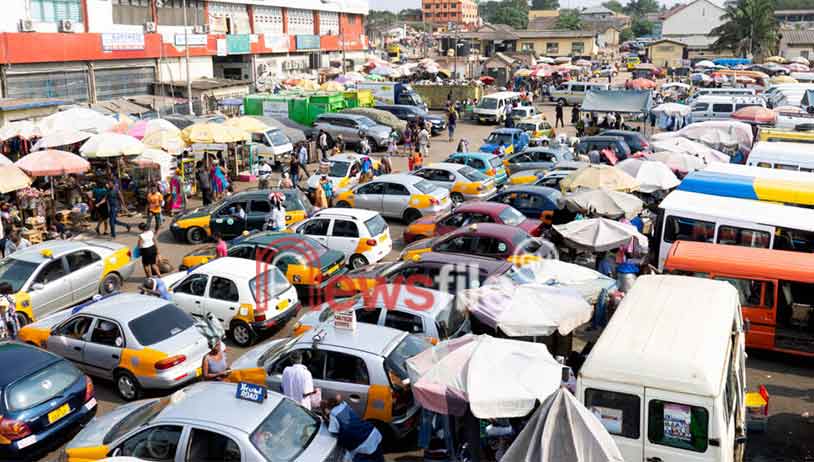
Ghana’s government has moved to address growing public transport congestion, blaming the situation on unlawful practices by some private operators and announcing immediate measures to ease commuter hardship.
Responding to questions from TV3 reporter, Komla Klutse at the Government Accountability Series, the Minister in charge of Government Communication, Hon. Felix Kwakye Ofosu, said investigations had revealed that certain transport operators were deliberately creating artificial shortages to charge passengers higher fares, despite recent reductions in fuel prices.
Hon. Kwakye Ofosu described the practice as “rent-seeking behaviour”, explaining that some drivers were avoiding designated loading points and roaming stations to exploit commuter desperation. He said the conduct violated long-standing agreements between government and transport unions, including the Ghana Private Road Transport Union (GPRTU), which allow fare adjustments only twice a year unless extraordinary circumstances arise.
“Transportation in Ghana is largely private sector-driven, but operators must play by the rules,” the minister said, warning that government would act against those exploiting passengers.
To ease the congestion, Kwakye Ofosu said the Minister for Transport had ordered the State Transport Company (STC) to redeploy dozens of buses onto key routes. The intervention, which had previously reduced pressure during the festive season, would be reinstated following a resurgence of congestion after the withdrawal of the vehicles.
In addition, several Metro Mass Transit buses that had broken down are being fast-tracked for repairs and will return to service within days. The buses are expected to operate outside their usual routes and schedules to help clear bottlenecks in major transport hubs.
The transport minister is also expected to meet with the GPRTU and other transport operators to address the issue directly and caution members against practices that worsen commuter hardship.
Kwakye Ofosu said there was no justification for fare manipulation, noting that fuel prices, spare parts costs and import duties had all declined in recent months. “The evidence is clear,” he said, adding that data from the ports showed a significant reduction in duties paid on imported vehicle parts.
While acknowledging that government continues to expand its role in public transport through investments in Metro Mass Transit, the minister stressed that the sector remains predominantly private. He urged operators to adhere to regulations and avoid exploiting passengers, warning that enforcement of bylaws and sanctions would follow if the situation persisted.
The government, he said, remains committed to restoring order and ensuring affordable, reliable transport for the public.