
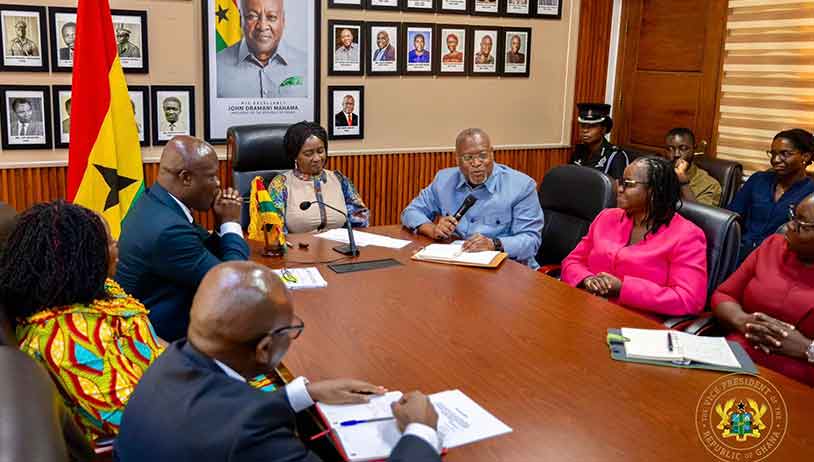
The Ministry of Local Government, Chieftaincy and Religious Affairs has reaffirmed its central role in advancing Ghana’s decentralisation agenda, with renewed emphasis on responsive governance and effective service delivery at the local level.
During a working visit to the Ministry, officials outlined progress made under the leadership of the sector minister, Hon. Ahmed Ibrahim, as part of broader government efforts to bring governance closer to communities. The engagement offered an opportunity to review ongoing reforms and assess measures aimed at strengthening institutions and improving public accountability.
Briefing the delegation, Hon. Ibrahim highlighted the successful orientation of Metropolitan, Municipal and District Chief Executives (MMDCEs), noting that clear operational guidelines had been issued on the prudent use of the District Assemblies Common Fund (DACF). He said the initiative was intended to ensure that decentralised resources are deployed efficiently and transparently to meet local development priorities.
The minister also pointed to the recently held National Decentralisation Dialogue, describing it as a critical platform for stakeholders to contribute to shaping the next phase of Ghana’s decentralisation journey. According to him, the dialogue underscored the need for collaboration across government, civil society and traditional institutions to strengthen grassroots governance.
Hon. Ibrahim further stressed the Ministry’s commitment to deepening engagement with traditional authorities, reporting a marked increase in consultations with chiefs and queen mothers nationwide. As part of efforts to recognise their role in local governance and social cohesion, allowances for paramount chiefs and queen mothers have been increased by approximately 300 per cent, a move the minister said reaffirmed their importance in national development.
On sanitation, the minister announced the launch of National Sanitation Day work plans ahead of the rollout of a 24-hour sanitation programme aimed at improving public hygiene across the country. He added that improved policy clarity and institutional stability had renewed confidence among investors and development partners.
In remarks during the visit, it was noted that the Ministry occupies a pivotal position within government, particularly as efforts intensify to reset the decentralisation agenda and strengthen social governance. Emphasis was placed on the role of decentralisation as a tool for enhancing everyday life and promoting peace in communities.
Appreciation was also expressed for measures to ensure that public funds, especially DACF disbursements, are used for their intended purposes. The visit concluded with a call for collective responsibility in governance, underscoring the need for respect and collaboration among all stakeholders to deliver meaningful outcomes for citizens.