
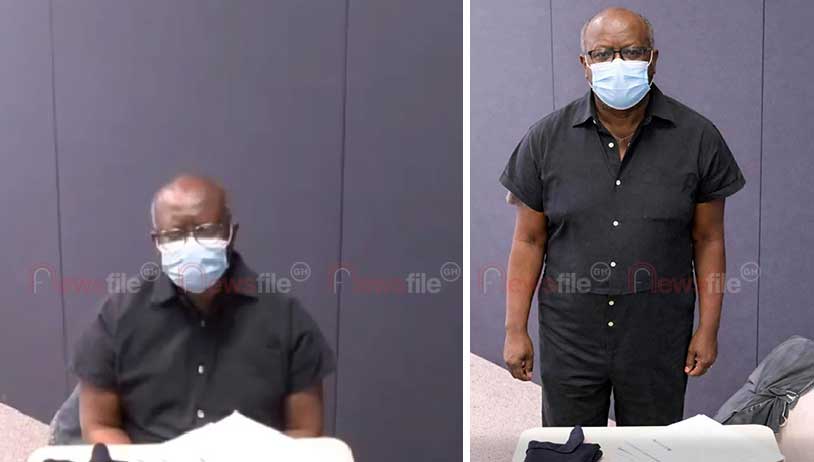
Anti-corruption campaigner Edem Senanu has described as “deeply embarrassing” images of Ghana’s former finance minister appearing in a foreign courtroom dressed in prison attire, calling the episode a sobering moment for the nation and a stark warning to public officials.
Speaking during a public discussion, Senanu, co-chair of the Citizens Movement Against Corruption, said few Ghanaians could have imagined that a former holder of one of the country’s most powerful offices would be seen on screen in a foreign jurisdiction “wearing the garb of the prisons there”.
“I don’t think we should have this discussion without thinking about our pride and what it does to us as a people,” Senanu said. “This is still a Ghanaian, regardless of political affiliation. I feel embarrassed that we have allowed ourselves to get to this situation.”
Senanu traced the circumstances that led to the former minister’s arrest, citing travel movements and visa renewals after he entered the United States in January on a six-month visa. By May, he said, the former minister relocated to the United Kingdom, obtained another six-month stay and returned, but by June an international red notice had been issued, significantly limiting his ability to travel.
“That cycle could no longer repeat,” Senanu said, arguing that the red notice effectively left the former minister stuck abroad until January, when an extradition request followed. “Look at how complicated his life has now become, just trying to avoid accountability,” he added.
The anti-corruption advocate said the episode should serve as a cautionary tale for politicians and technocrats, warning against trivialising allegations of wrongdoing. “You may think you are untouchable today, but in a few years’ time you could end up in a situation like this,” he said.
Senanu used the moment to renew calls for stronger ethical standards in public life, urging Parliament to pass the long-delayed Conduct of Public Officers Bill. He said ethical leadership required public officials to know what is right, do what is right and influence others to act accordingly.
“We need to move beyond voluntary commitments and codes that people can choose to ignore,” he said. “This must be a legally binding, actionable law that compels office holders to account for their stewardship.”
He argued that senior officials should not need legal advisers to tell them to return home to answer questions. “At that level, you should know yourself that you must come back and account for your time in office,” Senanu said.
Responding to suggestions that the former minister was not evading accountability, Senanu said there was no publicly available medical or flight-risk report indicating that he was unable to return to Ghana. “There is no evidence that his health prevents him from travelling, and no indication that he cannot board a plane,” he said. “So what is the issue?”
Legal scholar Prof Kwaku Ansa-Asare, also speaking during the discussion, said even if the former minister returned with medical documentation, a Ghanaian court would be competent to assess the situation and determine whether he should be allowed to travel for treatment.
Senanu noted that civil society groups had initially criticised the Office of the Special Prosecutor when it sought action against the former minister, citing health concerns at the time. “We said, let the man go and return,” he said. “But now he has gone, and the evidence suggests there is nothing preventing him from coming back. That makes us all more responsible to insist that he does.”
He said prolonged legal manoeuvres abroad only deepened public discomfort. “Instead of this rigmarole, where we see him on a screen in a foreign land wearing prison clothing, he should come home and answer the questions,” Senanu said. “It is sad, but he brought it upon himself, together with those advising him.”
The case has intensified debate in Ghana over accountability, the conduct of public officials and the reputational cost to the country when high-profile figures face legal trouble overseas.