

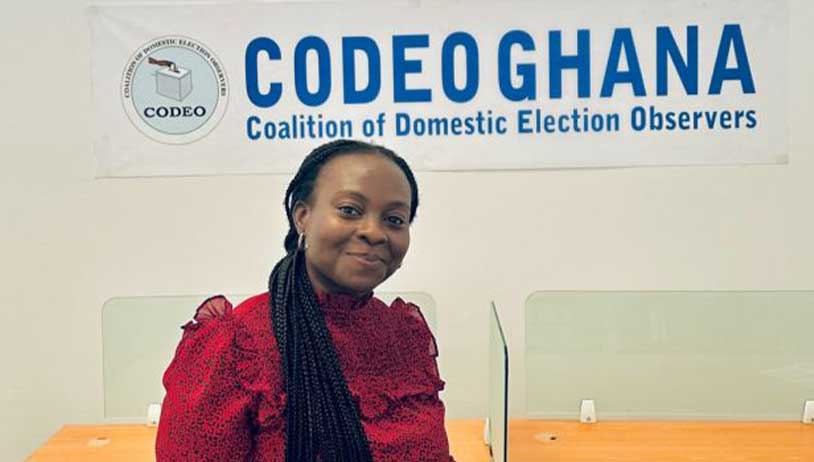
The policy think tank CDD-Ghana has called for a nationwide debate and sweeping legal reforms on political financing, warning that unchecked campaign spending and vote-buying threaten democratic credibility and public trust.
Speaking on the current affairs programme Newsfile on JoyNews, programmes officer Vera Abena Addo said Ghana’s existing political finance laws are outdated and insufficient, allowing candidates to bypass disclosure requirements and distribute money or gifts to voters with little oversight.
The discussion, hosted by broadcaster Samson Lardy, centred on growing public concern over inducements in internal party contests and national elections. Abena argued that recent controversies have sparked overdue national attention, describing the moment as an opportunity to build consensus for reform rather than a missed chance for accountability.
“For once somebody has been sanctioned for vote-buying,” she said, noting that enforcement has historically been rare. She referenced efforts by the Office of the Special Prosecutor to pursue such cases, including one in Kumasi that failed in the High Court due to insufficient evidence. According to her, the ruling illustrated how difficult it is to prove inducement under current legal standards.
Abena pointed out that Ghana’s Political Parties Act focuses primarily on parties rather than individual candidates, creating loopholes that allow campaign funds to be channelled privately. “Donations go to the candidates, not the party,” she explained. “So we need a comprehensive law that requires candidates themselves to disclose their funding sources and file reports.”
She added that rising campaign costs are distorting political competition, effectively excluding young or less wealthy aspirants. Research cited by CDD-Ghana suggests the sums required to contest primaries and general elections have escalated sharply, creating incentives for candidates to recover expenses once in office, sometimes through questionable means.
Analysts say the problem reflects both supply and demand. While candidates often offer money or goods, some delegates and voters expect such incentives. Abena stressed that reform must address both sides, including civic education campaigns to help citizens understand the long-term consequences of accepting inducements.
She revealed that CDD-Ghana has already prepared a draft bill on political finance and is working with the Attorney General’s office and a panel of legal scholars and policy experts to refine it. The group plans nationwide consultations to gather input from communities, regional stakeholders and political actors before presenting final proposals.
Among the reforms under discussion are stricter disclosure rules, caps on campaign spending, clearer definitions of inducement and corruption, and stronger sanctions for violations. Abena said the organisation is also examining abuses of incumbency, such as misuse of state resources for campaign purposes which it monitored during the 2024 elections through its Corruption Watch initiative.
The debate has drawn attention across party lines. Members of both the opposition New Patriotic Party and the governing National Democratic Congress have participated in consultations, according to Abena, with many acknowledging privately that spiralling campaign costs place heavy financial strain on candidates.
Legal expert and former lawmaker Hon Inusah Fuseini, who also joined the discussion, said excessive spending in elections can have serious consequences for governance. Money used to secure votes, he argued, is rarely a charitable gesture. “Whoever spends money in an election is not Father Christmas,” he said. “You recoup the money sharply, and the country suffers.”
Hon Fuseini warned that an open-ended campaign financing system risks creating links between political funding and illicit activities, including illegal mining. Such connections, he said, undermine public confidence and weaken state institutions.
Abena agreed, adding that Ghana could learn from other democracies that impose strict campaign timelines and spending limits. She cited observations from elections in Côte d’Ivoire, where official campaigning lasted only two weeks. Although no system is flawless, she said, structured limits can reduce excessive expenditure and level the playing field.
The push for reform comes as Ghana reviews broader constitutional and governance frameworks. Recommendations from the Constitution Review Committee include regulating campaign periods outside election seasons and tightening rules on political financing. Abena welcomed those proposals, saying they align with long-standing calls from civil society groups.
She also emphasised the need for public engagement beyond elite policy circles. CDD-Ghana plans town-hall meetings and regional forums to discuss the draft legislation and gather citizen perspectives. Early feedback from radio call-in programmes and community interactions suggests growing frustration among voters about the influence of money in politics.
“People are not just upset because they’re not receiving anything,” she said. “They are upset because they see that it’s not fair and it affects the quality of leadership.”
Observers say the issue extends beyond national politics. Reports of inducements have surfaced in student and even school-level elections, highlighting how entrenched the practice has become culturally. Abena warned that without systemic reform, such patterns could normalise transactional politics for future generations.
Supporters of reform argue that transparency and enforcement, rather than moral appeals alone, will be crucial. They contend that clear legal standards, independent monitoring and meaningful penalties could deter vote-buying and restore public confidence in electoral processes.
For now, CDD-Ghana hopes the renewed public debate will translate into legislative action. “We can’t continue to have money influencing our politics and governance,” Abena said. “It is worrying, and we need to find a way out.”
Whether policymakers will seize that momentum remains uncertain. But analysts agree that as campaign costs climb and allegations of inducement persist, pressure is mounting on Ghana’s political establishment to confront the issue directly or risk further erosion of trust in the democratic system.