

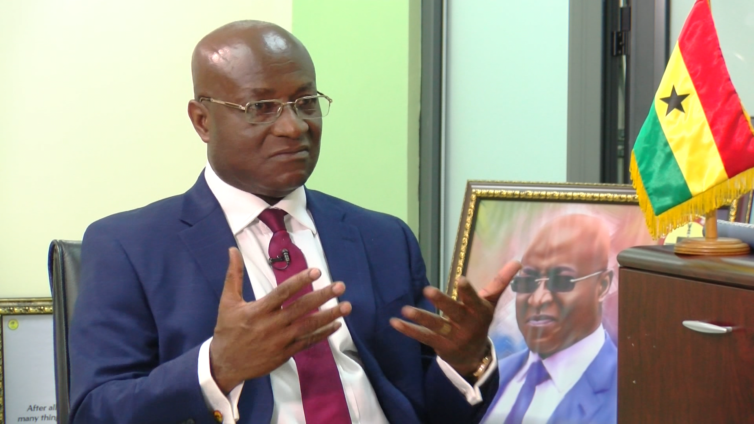
Senior statesman Osei Kyei-Mensah-Bonsu has warned that politically motivated ministerial appointments risk weakening governance, renewing his call for reforms that would prioritise expertise over political expediency in cabinet selections.
Speaking on proposals to separate ministerial appointments from parliamentary membership, the former Majority Leader argued that appointing technocrats to head ministries would strengthen policy direction and improve national development outcomes. He criticised what he described as a recurring practice in which individuals are reassigned to portfolios outside their competence for political convenience.
“A person may be ignorant in a field, yet just for political convenience he is taken to another sector,” he said, questioning how such officials could effectively shape policy or advise the president in specialised areas.
He cited examples of ministers vetted and approved for one portfolio, such as energy, only to be reshuffled later into entirely different sectors like agriculture without undergoing further parliamentary scrutiny. According to him, this undermines accountability and leaves legislators and the public uncertain about a minister’s suitability for the new role.
Kyei-Mensah-Bonsu contrasted the situation with systems such as that of the United States, where ministers or secretaries are typically appointed for their professional proficiency in specific sectors and removed rather than reshuffled if performance proves unsatisfactory.
He also addressed proposals suggesting that lawmakers who resign from Parliament of Ghana to accept ministerial appointments should be barred from joining government until the end of the parliamentary term. While acknowledging the intent behind the recommendation, he said exceptions might be necessary in cases where a highly qualified individual is best suited for a role.
Still, he maintained that if a legislator accepts an executive appointment, they should relinquish their parliamentary seat entirely and trigger a by-election, arguing that such a system would clarify institutional roles and reinforce accountability.
His remarks add momentum to ongoing debates in Ghana about constitutional and governance reforms aimed at strengthening democratic institutions and ensuring that ministerial appointments are driven primarily by competence rather than political calculation.