

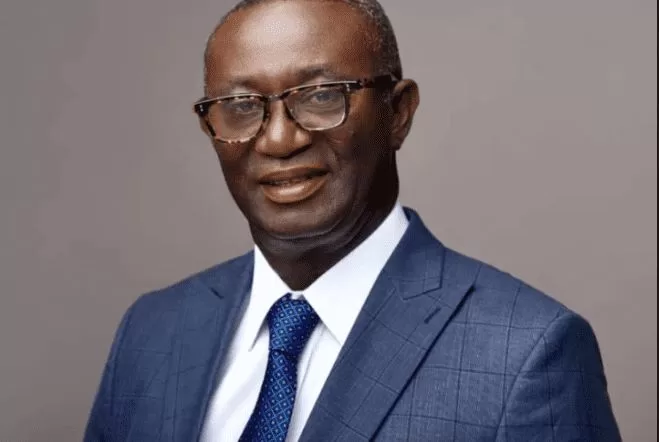
Former Asante-Akim North MP Andy Kwame Appiah-Kubi has publicly criticised the practice of paying for political support, admitting that he and other politicians have participated in inducements during internal elections and warning that the trend threatens Ghana’s democratic standards.
Speaking on The Key Points on TV3, the former lawmaker said vote-buying has become so normalised within party politics that condemning it selectively would be dishonest.
“Is it true? Oh well, yes, it’s true,” he said when asked about allegations that aspirants pay delegates for support. “In fact, there was even an occasion that I gave an interview after our primaries and I mentioned that if this is the way we are going, I will not contest any elections. And indeed, all of us are guilty. We have all participated in this thing we’re doing, including me.”
Appiah-Kubi’s comments come amid heightened national debate over inducements in party primaries, following recent controversies in internal contests across the political spectrum. He argued that the openness with which money is sometimes distributed makes it unnecessary to search for proof.
“For me, I would have thought that this thing was more open than any one that we have witnessed, and so we didn’t have to go to any length to find evidence,” he said.
Call for stricter party action
The former MP suggested that political parties should act decisively the moment credible reports of inducements surface, rather than waiting until after voting has taken place. Using a hypothetical example involving the National Democratic Congress, he said parties have constitutional room to cancel primaries if irregularities arise.
“When the law says select a candidate on your ticket, it does not say ‘by all means elect’,” he explained. “Most party constitutions have a caveat that says ‘except where the National Executive Council decides otherwise’, which means there could be another way of selection.”
According to him, if party leadership had disqualified candidates suspected of distributing money before voting, they could have chosen a representative through an alternative process rather than allowing a tainted contest to proceed.
Legal challenges in proving corruption
Appiah-Kubi also questioned whether criminal investigations alone can effectively tackle the issue. He noted that corruption requires proof that a gift influenced a voter’s decision, which is difficult to establish because ballots are secret.
“Corruption doesn’t mean only giving money or taking money,” he said. “It has an inherent element of you having been influenced by the material gain to do something otherwise than you would have done.”
He argued that even if a voter accepts money, it is nearly impossible to prove how that person ultimately voted. “When he is voting, he has the opportunity to decide not to vote for me as I expected, and nobody can prove it,” he said.
For that reason, he suggested that the Office of the Special Prosecutor faces a “tall order” if it attempts to prosecute such cases solely on inducement allegations.
Cost of politics discouraging participation
Beyond legal issues, the former legislator warned that the rising cost of political contests risks deterring capable candidates who lack financial resources. He said he is personally reluctant to run again because he cannot afford the sums reportedly spent in primaries.
“I don’t see myself finding such huge monies and putting that in elections,” he said. “In the history of my participation in elections I don’t think there is any material benefit that I can point out to justify the kind of investment.”
He challenged fellow lawmakers to state publicly whether campaign spending can realistically be recovered through legitimate earnings while in office. According to him, it cannot.
“I bet every parliamentarian to come and tell me that the money you spent in your election, you’ll be able to realise it in your period as an MP. You will not, unless there’s any wrongdoing somewhere,” he said.
He added that many people mistakenly believe MPs receive extensive financial perks, stressing that official vehicles, often cited as benefits, are not free but paid for gradually from salaries.
“The only thing that we politicians get out of the system are the V8 vehicles, and that one, it is upon your salary we pay for it,” he said. “Every month you will continue to defray the cost.”
Proposed reforms to reduce inducement
To curb vote-buying, Appiah-Kubi proposed widening participation in primaries so that all registered party members, rather than a small, identifiable group of delegates, can vote. He believes inducements flourish partly because aspirants can easily target known delegates.
He suggested a system in which large numbers of members attend a voting venue but only a limited proportion are randomly selected to cast ballots, making it harder for candidates to predict who will vote.
“If there’s a constituency expecting 5,000 people to vote freely, do 4,400 ‘no’ votes and 600 ‘yes’ votes,” he said, describing a hypothetical selection mechanism. “When you select a ‘yes’ vote, you proceed to vote, so that the delegates are not known before the voting.”
Such a system, he argued, would reduce the incentive to distribute money because candidates could not be certain which individuals would actually vote.
Wider implications for democracy
Political analysts say Appiah-Kubi’s remarks are notable because they reflect a rare public admission from a senior political figure that inducements occur across party lines. His statement that “all of us are guilty” underscores concerns that the problem is systemic rather than isolated.
Transparency advocates warn that vote-buying undermines merit-based selection, allowing wealthier aspirants to outspend rivals instead of persuading supporters through policies or competence. Over time, they say, this can weaken governance by elevating candidates chosen for financial strength rather than leadership ability.
Appiah-Kubi echoed that concern, arguing that inducements do not produce the best representatives. “It is not good; it doesn’t bring the best candidate,” he said.
Debate likely to intensify
His comments are expected to fuel ongoing national discussion about reforming internal party elections, an issue that has gained prominence following several disputed primaries and allegations of inducements in recent years. Civil society groups have repeatedly called for stricter enforcement of party rules and stronger transparency mechanisms.
For now, however, Appiah-Kubi maintains that meaningful change must begin within the parties themselves. Without internal discipline, he suggested, legal enforcement alone will not solve the problem.
“If we want credible leadership,” he said, “then the system that produces that leadership must also be credible.”
His remarks highlight a central dilemma facing Ghanaian politics: while inducements are widely criticised, they remain difficult to detect, harder to prove and deeply embedded in the mechanics of competitive internal elections.