

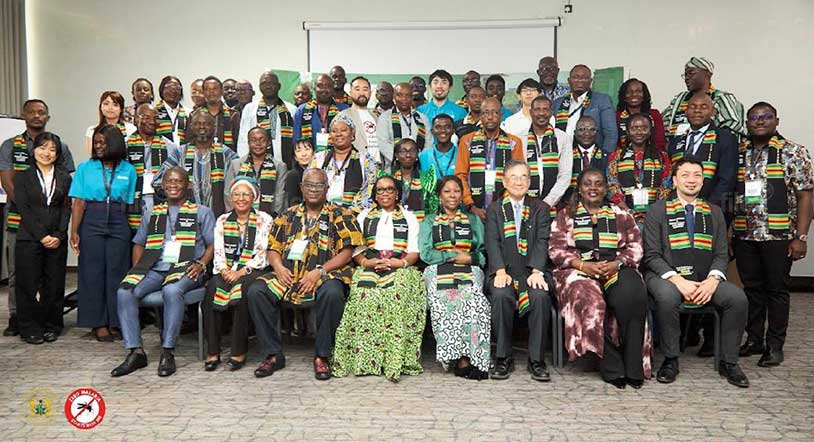
Health leaders and technology experts from across Africa have gathered in Accra for a high-level summit focused on deploying digital innovations to transform malaria prevention, with officials urging a transition from reactive treatment to predictive, data-driven control strategies.
Delivering the keynote address, Deputy Health Minister Grace Ayensu-Danquah said African countries must embrace advanced tools capable of detecting mosquito breeding grounds before infections spread, describing proactive prevention as essential to eliminating the disease.
The two-day workshop, held at The Palms by Eagle Hotel, is organised by the National Malaria Elimination Programme under the Ghana Health Service in partnership with AGAMAL and SORA Technology. The event is being attended by policymakers, researchers and innovators from multiple countries under the theme “Prevention at the Source”.
“If we are to end malaria, we must outpace it,” Ayensu-Danquah said. “Technology now gives us the power to predict, detect and respond with precision. Prevention at the source is not just a strategy, it is our responsibility.”
Organisers say the workshop highlights a growing continental consensus that targeting mosquito breeding habitats known as Larval Source Management could significantly reduce transmission if supported by accurate surveillance and rapid intervention systems.
Demonstrations showcased a range of digital tools designed to modernise malaria control operations. These include drone-based mapping systems paired with artificial intelligence capable of identifying stagnant water sites, digital micro-planning platforms that allocate resources based on real-time data, and monitoring technologies that allow field teams to track and adjust interventions instantly.
Experts said such tools could improve efficiency in resource-limited settings by enabling health authorities to concentrate efforts in high-risk areas rather than relying solely on widespread treatment campaigns.
Ayensu-Danquah praised collaboration between governments and private innovators, stressing that eliminating malaria will require coordinated cross-border action, shared technical knowledge and sustained political commitment. She said the presence of participants from different regions demonstrates Africa’s capacity to generate home-grown solutions rather than relying exclusively on external interventions.
“This gathering shows that Africa is not waiting for solutions we are building them,” she said.
Participants described the forum as a critical platform for exchanging research findings, operational experiences and policy approaches, particularly for countries facing similar malaria burdens. Officials added that such cooperation could accelerate adoption of proven strategies and strengthen regional disease surveillance networks.
The Ministry of Health said it remains committed to supporting national and international partners as they scale up technology-enabled malaria programmes. Authorities believe sustained investment in innovation, combined with community engagement and regional coordination, could move Ghana and other African nations closer to the long-term goal of eliminating malaria as a public health threat.