

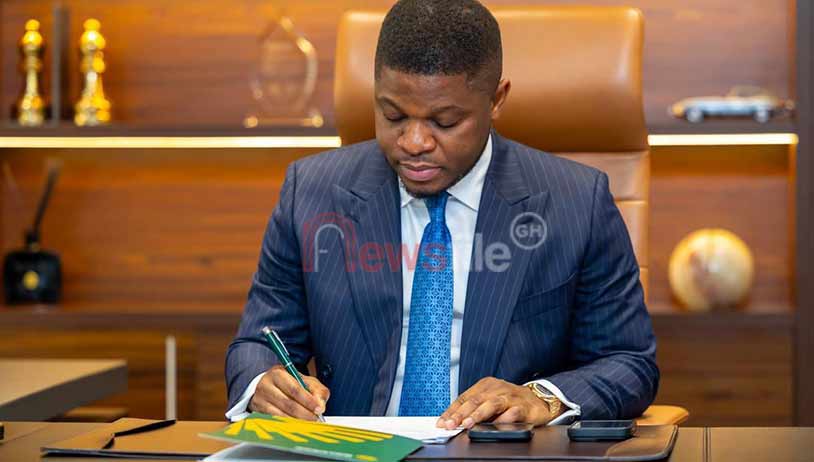
The Chief Executive Officer of the Ghana Gold Board (GoldBod), Sammy Gyamfi, has dismissed claims circulating in sections of the media that the institution incurred losses in its gold trading operations, insisting the Board recorded significant profits in 2025 and contributed substantially to Ghana’s economic recovery.
In a detailed statement, Mr Gyamfi said GoldBod’s unaudited financial statements, published on its website, show the institution is on course to declare an income surplus of not less than GH¢600 million for the 2025 financial year. He stressed that the Board “has made no losses” since commencing operations.
He clarified that in 2025 GoldBod’s mandate was limited to the local purchasing, assaying and export of gold for the Bank of Ghana (BoG), adding that the actual selling or trading of the gold to off-takers falls exclusively under the central bank’s authority.
Mr Gyamfi said GoldBod was unaware of any reported $214 million loss allegedly incurred by the BoG under the Gold for Reserves Programme and attributed to so-called “GoldBod off-taker fees”. He described such claims as inaccurate, noting that the BoG’s Gold for Reserves and Gold for Forex programme accounts for 2025 are yet to be audited.
“For the record, there is nothing like ‘GoldBod off-taker fees’ under the ASM gold trading programme,” he said, explaining that GoldBod does not deal with off-takers and does not charge such fees. According to him, all off-take agreements are negotiated and executed by the BoG, which applies standard discounts for freight, insurance and refining.
He said the only charges payable to GoldBod are a statutory assay fee of 0.25 per cent and a service charge of 0.5 per cent, inherited from a 2023 gold purchase agreement between the BoG and the defunct Precious Minerals Marketing Company. He emphasised that these charges have not been increased in 2025 and that commissions paid to licensed buyers are borne by the BoG.
Mr Gyamfi highlighted GoldBod’s wider economic impact, stating that the Board generated more than $10 billion in foreign exchange in 2025 alone through the local purchase of over 100 tonnes of artisanal and small-scale mining (ASM) gold for the BoG. He added that GoldBod also acquires 20 per cent of the output of nine large-scale mining companies to bolster national gold reserves.
He linked these inflows to a rise in Ghana’s gross international reserves from about $9 billion in 2024 to approximately $12 billion in 2025. The strengthened reserves, he said, have contributed to a more than 35 per cent appreciation of the cedi against the US dollar this year, reduced debt servicing costs, helped keep inflation in single digits and eased the cost of living.
“The economic benefits of GoldBod’s operations are simply unquantifiable,” Mr Gyamfi said, questioning how the economy would have fared without the foreign exchange generated from ASM gold trading.
He noted that GoldBod, barely eight months old, has so far operated largely as an agent of the BoG, relying on statutory fees as internally generated funds to sustain its activities as a non-subvented state agency.
Looking ahead, Mr Gyamfi said GoldBod will fully take over the ASM gold trading programme from January 2026, assuming responsibility for purchasing, trading and selling gold without any fee obligations to the BoG. He expressed confidence that the Board would deliver strong returns using government-allocated revolving capital, declaring that “the future is bright for Ghana.”