

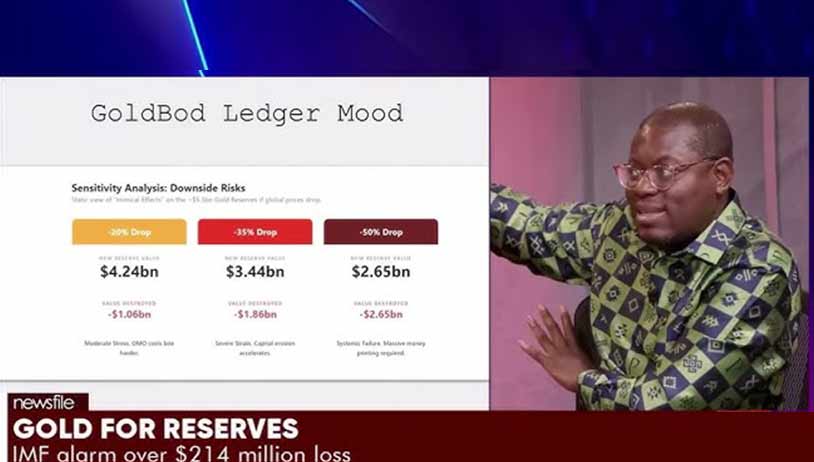
A heated panel discussion on Joy Newsfile has reopened debate over the efficiency, risks and transparency of Ghana’s GoldBod and the Bank of Ghana’s gold-linked programmes, with policy analyst Bright Simons arguing that claimed economic benefits do not eliminate the need for rigorous scrutiny of costs and losses.
Simons, vice-president in charge of research at the IMANI Centre for Policy and Education, said policies designed for national benefit must still be assessed for efficiency, even when they are not profit-driven. He compared the GoldBod to other statutory policy institutions such as COCOBOD, noting that while COCOBOD exists primarily to support farmers and stabilise foreign exchange inflows, its losses are routinely tracked and debated.
“If we are willing to interrogate the efficiency of COCOBOD’s use of resources, we cannot suddenly say the same logic does not apply to the GoldBod,” Simons said, adding that policy purpose does not exempt institutions from accountability.
He extended the argument to fuel and energy subsidies, which governments have historically justified on social welfare grounds despite mounting fiscal costs. Simons said such policies may have political justification, but analysts are still entitled to question whether they are efficient or sustainable.
The discussion followed earlier remarks by GoldBod Chief Executive Sammy Gyamfi, who has consistently defended the gold-for-reserves (G4R) programme as a strategic intervention that has stabilised the economy, strengthened the cedi and reduced inflation. Gyamfi has argued that what critics describe as “losses” are intentional policy costs incurred to secure larger macroeconomic benefits.
Simons disagreed with the framing, citing the International Monetary Fund’s assessment that the programme recorded trading losses. He said a trading loss, by definition, means gold was bought at one price and sold at a lower realised value, and cannot be reclassified as a purely administrative or accounting matter.
“The IMF looked carefully at the data and concluded there were trading losses,” Simons said. “You cannot convert a trading loss into something else simply by changing the language.”
He warned that persistent losses could erode the revolving working capital used to buy gold, eventually limiting the GoldBod’s ability to operate at scale. While acknowledging improvements in transparency under the current management, Simons said disclosure remains inadequate given the scale of risk involved.
One of his central concerns was concentration of risk around the role of the sole aggregator, Barrock. Simons stressed that IMANI had not concluded investigations into ethical wrongdoing, but said the structure itself raised policy questions. He argued that self-financing aggregators, who borrow at commercial interest rates, are placed at a disadvantage when competing with an aggregator funded by interest-free state resources.
“Who will win that competition?” he asked, describing the model as inherently problematic without a level playing field.
Simons also questioned the opacity surrounding offtakers and financial guarantees backing the system, including insurance bonds and performance guarantees. He said understanding the full value chain from miners to aggregators, offtakers and final dollar inflows, was essential to rule out manipulation or hidden premiums.
On currency stability, Simons challenged what he described as over-attribution of economic gains to the GoldBod alone. He said Ghana’s cedi performance and inflation decline were also influenced by IMF programme benchmarks, fiscal consolidation and increased inflows from large-scale mining, and could not be credited solely to domestic gold purchases.
“Our analysis suggests only a portion of the currency gains can reasonably be attributed to GoldBod operations,” he said.
Despite his criticisms, Simons acknowledged that the gold programmes have contributed to economic stability at a difficult time and said IMANI welcomed recent openness from GoldBod management. However, he insisted that transparency must be “end-to-end” and competition enhanced if the model is to be sustainable.
The debate underscored sharp differences between government officials and independent analysts over how to balance strategic economic interventions with financial discipline, as calls for parliamentary scrutiny of the GoldBod’s operations continue.