

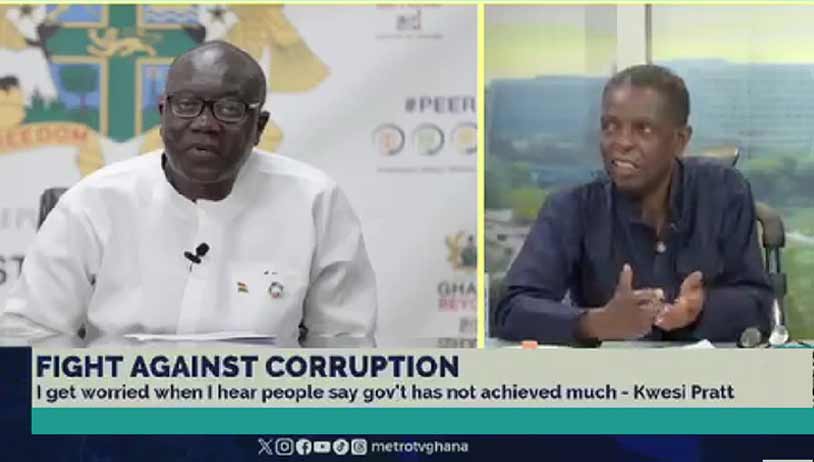
Veteran journalist Kwesi Pratt Jnr has raised sharp questions about former finance minister Ken Ofori-Atta’s continued absence from Ghana, arguing that health reasons cited to delay accountability have become increasingly untenable amid reports of his detention by United States immigration authorities.
The issue dominated discussions on Metro TV’s Good Morning Ghana, hosted by Moro Awudu, as commentators examined conflicting accounts surrounding Ofori-Atta’s reported arrest by US Immigration and Customs Enforcement (ICE), the status of his visa and broader calls for former public officials to account for their stewardship.
Moro said Ofori-Atta is among former office holders being asked to respond to questions over their time in government, stressing that this does not amount to a declaration of guilt. For months, the public had been told the former minister was too unwell to travel to Ghana, with claims that his condition made flying impossible. Awudu noted, however, that reports now suggest Ofori-Atta had been physically active abroad, travelling within the United States and to the United Kingdom.
According to some sources cited on the programme, Ofori-Atta was detained by ICE while attempting to renew or extend his stay in the United States, allegedly after his visa had expired. A different account has been offered by Ghana’s Minister of Justice and Attorney General, who said the former minister’s visa was not expired but due to expire in February, and that his authorised period of stay had already lapsed.
The Attorney General later stated that Ofori-Atta’s US visa was revoked in July 2025, disputing earlier claims about an expired visa. While stopping short of a direct admission, the Attorney General appeared to suggest state involvement in the revocation process. Media reports indicate Ofori-Atta has spent about nine days at a detention centre in Virginia, with his lawyers challenging the legality of his detention.
Additional reports have suggested the former finance minister was arrested near central Washington, close to properties associated with senior US officials, and that ICE cleared him as medically fit prior to detention. There have also been claims that Ofori-Atta is pursuing US citizenship through his son, who was born and raised in America, though these reports have not been officially confirmed.
Pratt, managing editor of The Insight newspaper, said he recalled a period when Ofori-Atta appeared visibly unwell while serving as finance minister, prompting public calls for him to step aside. At the time, Pratt noted, Ofori-Atta insisted Ghana’s interests were paramount and said he was prepared to risk his health to continue serving.
“Why has the story changed now?” Pratt asked, questioning why health concerns were now being relied upon to avoid facing allegations. He argued that prostate-related conditions, which Ofori-Atta is widely reported to have, should not be used as grounds to evade accountability.
“Across the world, people with prostate issues work, stand trial and even serve sentences,” Pratt said, adding that such conditions are common among men over 40, including judges and other public officials.
Pratt said the former minister’s continued absence had worsened his situation and urged him to return to Ghana to address the allegations. He rejected suggestions that Ghana’s courts could be dismissed as biased or “kangaroo courts”, noting that the judiciary has largely remained unchanged since Ofori-Atta’s time in office and that many judges were appointed under the same administration.
He stressed that calls for accountability must be grounded in principle rather than politics, insisting on the presumption of innocence for all citizens. “He may well be innocent,” Pratt said, adding that due process must apply equally to members of all political parties.
Pratt warned against measuring the fight against corruption by financial recoveries alone, arguing that justice cannot be quantified in monetary terms. He called for strict adherence to the rule of law and fair treatment for all citizens, regardless of political affiliation.
“The pursuit should be justice,” he said, “not spectacle, not vengeance, but fairness and the consistent application of the law.”