

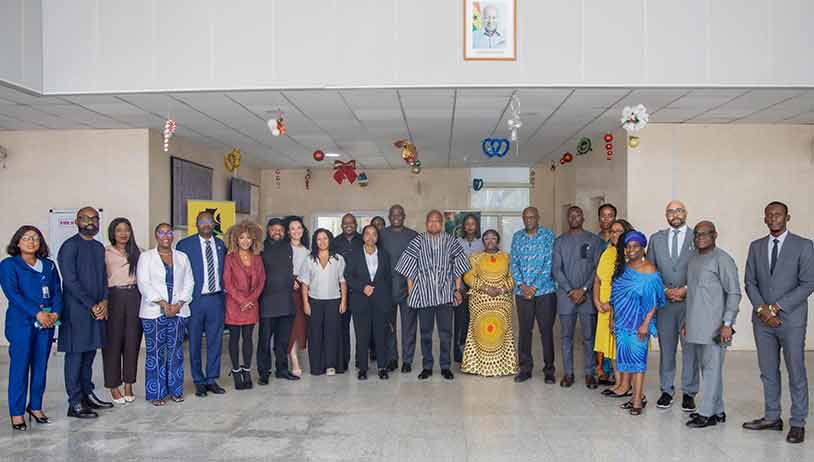
Ghana has deepened its push for reparative justice with a high-level engagement between the Minister for Foreign Affairs, Samuel Okudzeto Ablakwa, and a group of international experts and advocates on reparations, officials said Thursday.
The meeting, held Wednesday, Dec. 17, brought together experts from the African Union Economic, Social and Cultural Council (ECOSOCC), TrustAfrica and Reform Initiative, alongside advocates based in Africa, the Caribbean, Latin America, Europe and the United States. It forms part of Ghana’s broader efforts to advance global dialogue on reparations for the transatlantic slave trade and colonial exploitation.
Welcoming the delegation, Ablakwa reaffirmed Ghana’s longstanding commitment to championing the interests of Africans and people of African descent worldwide. He said the demand for reparations is rooted in justice, accountability and human dignity, stressing that the time had come for responsibility to be taken for historical atrocities linked to slavery and colonialism.
“The reparations agenda is not about charity,” the minister said, according to officials. “It is about justice, dignity and addressing historical wrongs whose impacts remain visible today.”
Ablakwa also underscored the commitment of President John Dramani Mahama, who serves as the African Union Champion for Reparations, to mobilising continental and global support to advance the cause. He said Ghana would continue to provide leadership in shaping a coordinated and credible reparations framework.
Ghana’s Special Envoy for Reparations, Dr. Ekwow Spio-Garbrah, praised the experts for their extensive work in the field and pledged close collaboration to achieve shared objectives. He noted that sustained engagement with scholars, policymakers and civil society would be critical to translating advocacy into measurable outcomes.
The Acting Chief Director of the Ministry of Foreign Affairs, Ambassador Khadija Iddrisu, called for the development of a clear roadmap and a unified global voice to strengthen the reparations movement. She emphasized the importance of leveraging shared knowledge, strategic partnerships and practical approaches to build a strong and persuasive case for reparations at international fora.
Representatives of the expert group commended Ghana for its leadership role and the establishment of an institutional framework through the appointment of a Special Envoy. They expressed solidarity with Ghana’s efforts and offered recommendations to strengthen the campaign, including sustained public education, regular and structured dialogue at national, continental and global levels, and the development of registers and documentation to support reparations claims.
The meeting concluded with a shared commitment to intensify cooperation and coordination as Ghana continues to position itself at the forefront of the global reparative justice movement.