

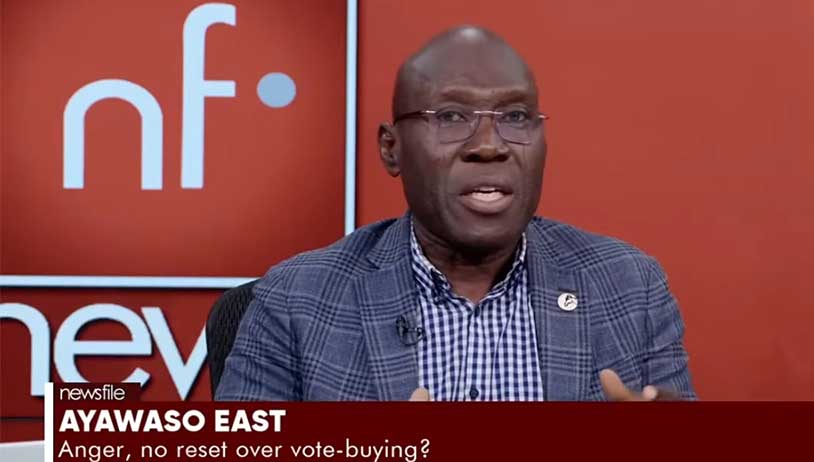
Allegations of vote buying during a parliamentary primary in Ayawaso East compromised the integrity of the contest and raised complex legal and governance questions for the opposition National Democratic Congress, according to party figure Hon Inusah Fuseini.
Speaking on Joy Newsfile with host Samson Lardy, Fuseini described the episode as a “difficult situation” that prompted action across multiple arms of leadership, including the party, Parliament and the presidency. He said each institution publicly condemned events surrounding the primary, calling the response unprecedented in Ghanaian political practice.
Hon Fuseini, a lawyer and member of a fact-finding committee established after the vote, said the panel concluded that four of the five candidates distributed goods or money to delegates, which it classified as inducements regardless of intention. Items allegedly shared included motorbikes, television sets, laptops, rice, clothing and other goods.
He said the prominence of candidate Baba Jamal in the controversy was largely due to his political profile and the fact that he won the contest, rather than evidence that he alone engaged in misconduct. Claims by supporters that gifts were distributed without a candidate’s knowledge did not persuade investigators, he added.
“The fact of giving, consequent upon an election primary, is that element of inducement,” Fuseini said, noting that timing or motive did not negate the effect on electoral fairness.
The committee determined that the widespread nature of inducements created a likelihood that the primary did not produce a winner through a genuinely free and fair process. It therefore suggested that party leaders could consider annulling the results, while warning that such a move would face significant legal and institutional obstacles.
Hon Fuseini argued that while a political party may wield political authority to overturn its own internal election, it must also establish a sound legal and rational basis for doing so. Otherwise, he said, it risks compounding problems rather than resolving them.
He cited philosophical arguments from Amartya Sen’s book The Idea of Justice to question whether punishing only one candidate when several allegedly committed similar infractions would amount to fairness. “If three people have done the same thing and one of them has won, why would you punish only one?” he asked.
The committee also highlighted legal complications stemming from the role of the Electoral Commission, which supervised and certified the primary. Fuseini said that although fraud can invalidate an election, allegations affecting a process overseen by a state institution would normally need to be tested in court.
Under Ghanaian law, he noted, there is a presumption that official acts are properly carried out unless proven otherwise. That means any attempt to overturn certified results must overcome a legal threshold, not merely a political one.
He warned that a unilateral annulment could raise broader governance concerns, particularly if it appeared to undermine the credibility of state institutions responsible for elections. Political parties, he said, are constitutionally required to conduct their affairs in accordance with democratic principles, including respect for institutional decisions.
“To be honest with you, you cannot deal with impunity by acting with impunity,” Fuseini said, stressing that disciplinary measures must rest on firm legal foundations.
The committee further concluded that the party’s constitution does not explicitly grant its Functional Executive Committee authority to annul a primary. The closest provision, he said, would allow the matter to be referred to the National Executive Committee, which can make determinations where party rules are silent.
Hon Fuseini explained that the investigative panel was established by the Functional Executive Committee and therefore submitted its findings to that body. It advised that any final decision should be escalated to the higher committee for constitutional and procedural reasons. Party leaders ultimately chose their own course of action after receiving the report, he added.
Timing also complicated deliberations. According to Fuseini, the report was presented only a day before the official filing deadline for parliamentary candidates, forcing leaders to weigh legal considerations against practical political realities, including whether the party intended to contest the seat.
During the discussion, Lardy observed that the New Patriotic Party constitution allows it in certain circumstances to appoint a parliamentary candidate directly. Fuseini acknowledged that such mechanisms could exist in other parties but emphasised that the committee’s mandate was limited to establishing facts and offering recommendations, not determining final outcomes.
He maintained that the Ayawaso East controversy should be viewed as evidence of institutional self-scrutiny rather than failure, arguing that public acknowledgement of wrongdoing can strengthen democratic credibility. According to him, it was significant that party structures, Parliament and the presidency all took positions condemning the alleged inducements.
Political analysts say allegations of vote buying in internal party contests are not uncommon in Ghana but rarely documented in such detail by official inquiries. Observers note that primaries can be as fiercely contested as general elections because they determine who will appear on the ballot, making them vulnerable to inducements aimed at influencing delegates.
Hon Fuseini said the committee’s findings underscored the need for stronger enforcement of internal rules and clearer constitutional provisions governing disciplinary action. Without such clarity, he warned, parties risk uncertainty whenever disputes arise over candidate selection.
He added that leaders must balance swift political decision-making with respect for due process, especially when allegations involve actions that could affect public confidence in democratic systems. “You must establish that political force on a legal, rational basis,” he said.
The controversy has intensified debate within political circles about how parties should respond to allegations of misconduct in their own ranks, particularly when legal, constitutional and practical considerations intersect. While the immediate dispute concerns a single constituency primary, analysts say the broader implications could influence how parties across Ghana handle internal electoral disputes in future.
For now, Hon Fuseini said, the central lesson is that accountability must be consistent and grounded in law if it is to command legitimacy among party members and the wider public.