

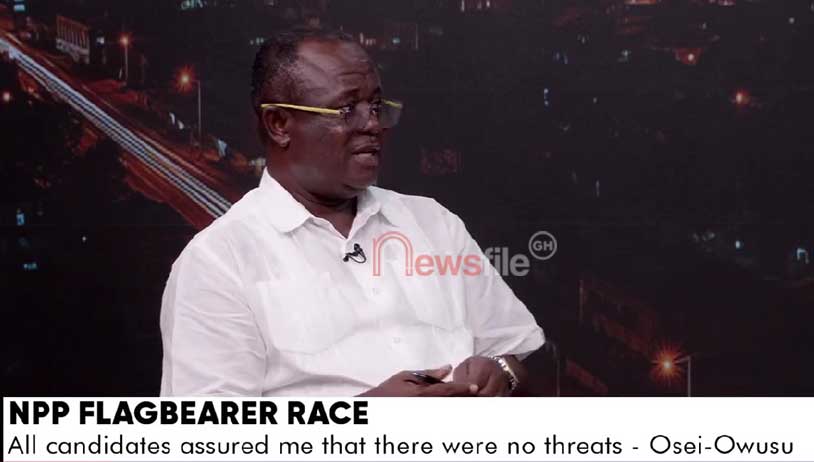
The chairman of the New Patriotic Party’s Presidential Elections Committee, Joseph Osei Owusu, has delivered a forceful assurance of integrity and transparency ahead of the party’s presidential primaries, declaring that he would rather “sacrifice my life” than preside over a process that compromises the party’s credibility.
Speaking in an interview on Face to Face, Osei Owusu underscored the NPP’s commitment to fairness, trust and due process as the party prepares to elect its flagbearer. He said safeguarding the integrity of the internal elections was not only a party obligation but a national responsibility, given the implications for Ghana’s democratic future.
Central to his remarks was the rationale behind the recently signed peace pact by the five presidential aspirants. According to Osei Owusu, the document was designed to secure public affirmation from contestants that the process had so far been inclusive, transparent and fair, and that they would accept the declared results and rally behind the eventual winner.
“The peace pact is an affirmation that they agree with the process and are prepared to accept its outcome,” he said. Copies of the document, he added, were circulated to all contestants or their agents three days ahead of the signing ceremony.
Osei Owusu addressed concerns raised by supporters of one aspirant, Kennedy Agyapong, suggesting the document had been seen for the first time at the ceremony. He rejected that claim, saying multiple copies had been handed to the candidate’s representatives in advance and that any confusion stemmed from internal communication lapses rather than the committee’s conduct.
He acknowledged that Agyapong had raised legitimate concerns based on experiences from the 2023 primaries, where alleged discrepancies were cited at the constituency level. However, Osei Owusu said those issues had already been discussed with the Electoral Commission (EC) and clear safeguards agreed.
“If we have evidence that anything untoward has happened that affects the integrity of the election, we will cancel it,” he said, reiterating a position he noted had been stated publicly on several occasions.
He explained that a refusal by an agent to sign results at a polling centre would not automatically invalidate those results. Disputes, he said, would first be addressed by the EC, and if unresolved, escalated for further scrutiny. Where irregularities are proven and deemed to affect the overall outcome, a re-run would be ordered in the affected area.
Osei Owusu said all five candidates had expressed satisfaction with the preparations so far and confidence in the neutrality of the committee, the EC and the security agencies. He added that the aspirants had jointly urged the police not to undermine the trust built throughout the process.
On the sensitive issue of whether he would vote in the primaries, Osei Owusu confirmed he would exercise his right but would not disclose his preference. Publicly endorsing a candidate, he argued, would undermine his ability to serve on the committee.
“My vote is secret,” he said. “If I declare my preference, then I have lost my right to be on this committee.”
He rejected suggestions that he should abstain entirely, maintaining that voting did not conflict with his duty so long as he upheld impartiality in administering the process.
Reflecting on the weight of his responsibility, Osei Owusu struck a solemn tone. “This election is not about me. It is about the NPP and the integrity of the process by which we select a leader,” he said. “If through my misconduct anything goes wrong, I have botched the country’s future.”
He said security preparations were robust, with the police and party leadership alert to intelligence reports and potential disruptions. The focus, he stressed, was on ensuring a peaceful, credible and uncontested outcome.
As the primaries draw near, Osei Owusu said the committee remains guided by principle rather than personalities. “All I expect is that everyone plays by the rules,” he said, reaffirming that trust, transparency and accountability would define the process.