

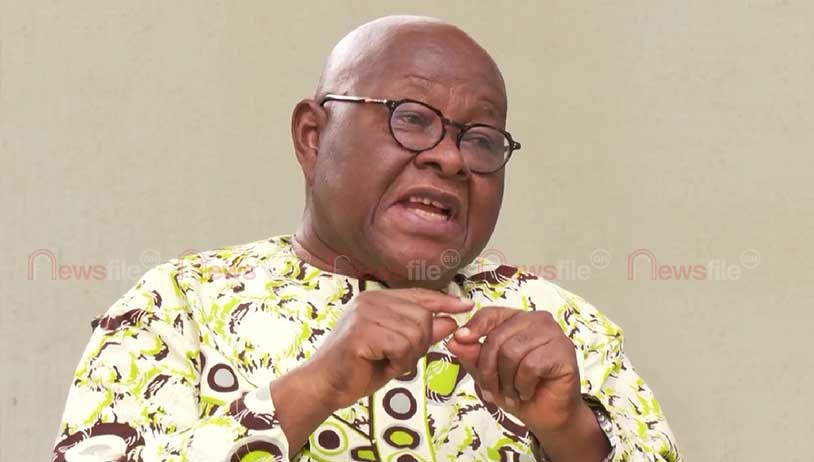
Former Speaker of Parliament and founding member of the New Patriotic Party (NPP), Prof. Mike Oquaye, has defended the party’s decision to hold an early presidential primary, describing the move as legal, constitutional, and designed to unify the party.
In a recent interview aired on TV3, Prof. Oquaye dismissed claims that the NPP is conducting an “upside-down” process, where the presidential candidate is selected before grassroots elections. “There is no upside down. Soon after the presidential election, we are going to the bottom-up approach,” he said, noting that the constitutional tenure of current executives had not lapsed and no amendments were necessary to conduct the election.
The former Speaker explained that the decision to choose a presidential candidate early is intended to provide the party with a standard-bearer, allowing it to resolve internal divisions and end ongoing schisms among party members. “We decided to select our presidential candidate early so that we shall have someone who will now stand for the party, and a lot of the schisms happening will end as soon as possible,” he said.
Responding to criticism from party members and public figures, including Dr. Nyaho Nyaho-Tamakloe, Prof. Oquaye emphasised that individuals who have distanced themselves from party activities cannot dictate party decisions. “Oh please, I do not want to talk about certain personalities, especially those who are opposing virtually everything. People who don’t attend our meetings, people who have excluded themselves from our party – they cannot decide things for us from sitting somewhere else,” he said.
Prof. Oquaye acknowledged that some party members initially misunderstood the process, leading to public reservations. “People who did not understand it made a lot of statements. Later on, they understood,” he noted, urging stakeholders to respect the authority of the party executive and the constitutional framework governing the primary.
He reaffirmed that the early presidential primary was well-intentioned, legally sound, and strategically aimed at presenting a unified NPP ahead of the next general elections. “It was well intended. Once this is over, other elections will take place as scheduled, following the constitution and party rules,” he added.
The interview comes at a time of heightened scrutiny of the NPP’s internal processes, with stakeholders observing how the early selection of a presidential candidate may impact party cohesion and preparations for the 2026 elections.