

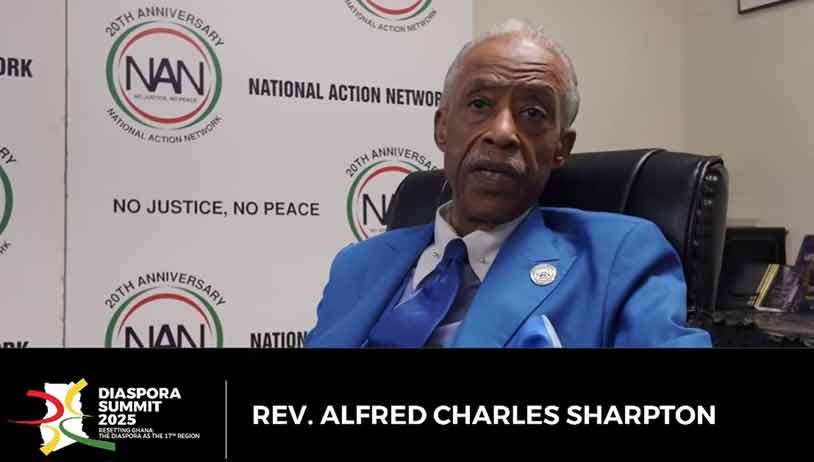
American civil rights leader Rev. Al Sharpton has paid a glowing tribute to Osagyefo Dr Kwame Nkrumah, describing the former Ghanaian president as a towering global figure whose legacy continues to inspire struggles for freedom and justice across Africa and the diaspora.
Sharpton made the remarks after receiving the Osagyefo Dr Kwame Nkrumah Award in recognition of his decades-long contributions to civil rights and social justice. He said it was an honour “even to be thought of in the same paragraph” as Nkrumah, whose ideas shaped generations of African and African-American activists.
Recalling his youth, Sharpton said that while some American progressives protested the Vietnam War carrying Mao Tse Tung’s “little red book”, young Black activists drew inspiration from what he called the “black book” of Nkrumah. He described Nkrumah as deeply significant not only to Africans on the continent but also to African Americans searching for political identity, dignity and self-determination.
Sharpton also reflected on a past visit to Ghana, where he toured the Kwame Nkrumah Memorial Centre and paid respects at the burial site of renowned scholar W.E.B. Du Bois. He noted that Ghana’s independence in 1957 resonated strongly within the US civil rights movement, recalling that Dr Martin Luther King Jr. and Congressman Adam Clayton Powell attended the independence celebrations.
However, Sharpton stressed that honouring Nkrumah’s memory must go beyond symbolism. He urged closer collaboration between Ghana and the African-American community, particularly in areas such as development, trade and international engagement.
“The African-American community needs to be side by side with Ghana,” he said, adding that such partnerships were vital in navigating relations with the United States and Western countries.
Sharpton said he accepted the award not only as recognition, but as a challenge and a call to action. He emphasised that Africans on the continent and in the diaspora face shared struggles and common systems of inequality.
Quoting his late pastor, Rev. William A. Jones Jr., Sharpton concluded by reminding the audience that “the blood that binds us is thicker than the waters that divide us”, reaffirming a shared destiny rooted in history, resilience and collective action
Below is the Video: