

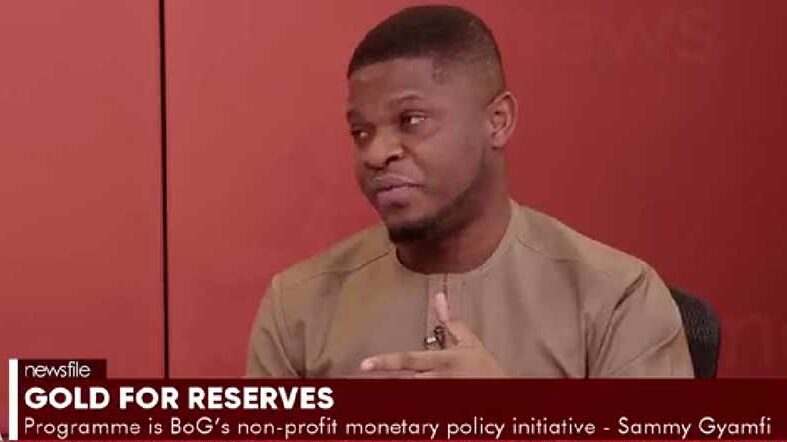
GoldBod Chief Executive Officer Sammy Gyamfi has offered an extensive clarification of the Ghana GoldBod’s trading model, pushing back against what he described as persistent misinformation about the state gold trading system and the role of licensed buyers, particularly aggregators.
Speaking during a panel discussion on Joy Newsfile hosted by Lawyer Samson Lardy Anyenini, Mr Gyamfi addressed claims that a single company is the sole buyer of gold for the Gold Board, describing the narrative as a fundamental misunderstanding of how the institution operates. He explained that GoldBod runs a structured four-tier licensing regime designed to ensure broad participation, accountability and effective risk management in the use of public funds.
According to him, the four categories of licensed buyers are tier one buyers, tier two buyers, self-financing aggregators and aggregators. All four categories, he stressed, are authorised to buy gold on behalf of GoldBod.
Tier one buyers, Mr Gyamfi explained, operate at the grassroots and are licensed to purchase gold directly from licensed small-scale miners. Tier two buyers are permitted to buy gold both from miners and from tier one buyers, creating a layered supply chain that supports aggregation at different levels.
The third category, self-financing aggregators, uses private capital to buy gold for GoldBod. The fourth category, aggregators, differs in that they are primarily funded by the Gold Board to purchase gold for the state.
“The difference is simple,” Mr Gyamfi said. “A self-financing aggregator uses his own money, while an aggregator receives funding from GoldBod to buy gold.”
He disclosed that in 2025, the first year of GoldBod’s operations, the board issued a total of 900 buying licences. Of these, 269 were tier one licences, 578 were tier two licences, 52 were self-financing aggregator licences, and one was an aggregator licence.
Mr Gyamfi said 31 applications were received for the aggregator category, but only one applicant, Barrock, met the eligibility criteria set by the GoldBod governing board. He emphasised that the approval process is not driven by management discretion.
“The governing board approves licences, not the CEO,” he said, adding that management only makes recommendations. He noted that aggregator licences can be suspended, revoked or expanded depending on compliance, stressing that the current situation could change if other applicants meet the requirements.
Mr Gyamfi said the aggregator licence is unique within Ghana’s regulatory environment because it entitles the holder to receive substantial state funds to purchase gold. Unlike bulk distribution companies or oil marketing companies, which rely on their own credit lines, aggregators are entrusted with taxpayers’ money, making strict safeguards unavoidable.
He outlined the minimum requirements for an aggregator licence, including at least three years’ experience in gold trading, audited financial statements for a minimum of three preceding years, at least three buying offices across the country, logistics such as a bullion van, and, most critically, a bank guarantee or advance payment guarantee from a recognised financial institution.
He revealed that Barrock provided an advance payment guarantee covering trade capital support of GH¢2 billion, which formed the basis for the board’s approval.
“We are not running a system where anyone can walk in and say they want to use taxpayers’ money to buy gold,” Mr Gyamfi said. “We buy gold worth three, four, sometimes five billion cedis every week, largely in cash. That is serious risk exposure.”
Reflecting on his tenure at the Precious Minerals Marketing Company (PMMC), Mr Gyamfi said three aggregators previously operated under that framework. Two were suspended in June 2025 for regulatory infractions, although their suspensions have since been lifted. He said those entities have reapplied for aggregator licences but have been unable to meet the current guarantee requirements.
Mr Gyamfi also clarified that Barrock is not the only entity funded by GoldBod. Rather, he said all licensed buyers ultimately receive GoldBod funds, but these are channelled through the aggregator. He added that if more aggregators are approved, funding would be distributed through all of them.
To illustrate the scale of operations, he disclosed that two licensed buyers supplied GoldBod with gold valued at GH¢13 billion and GH¢11.8 billion respectively over a four- to five-month period, using funds provided by the board.
He further confirmed that Barrock is registered and licensed to trade gold in Liberia, presenting documentation dating back to 2018 as evidence of its international operations.
Mr Gyamfi said his objective was to dispel myths and restore public confidence in GoldBod’s governance framework. He stressed that the system is designed to balance inclusivity with strong controls, ensuring transparency, accountability and the protection of public resources as Ghana consolidates its state-led gold trading regime.