

Ghana’s Supreme Court has issued comprehensive guidelines to assist trial courts in the equitable distribution of marital property upon divorce, reinforcing a contextual and evidence-based approach rather than an automatic equal split.
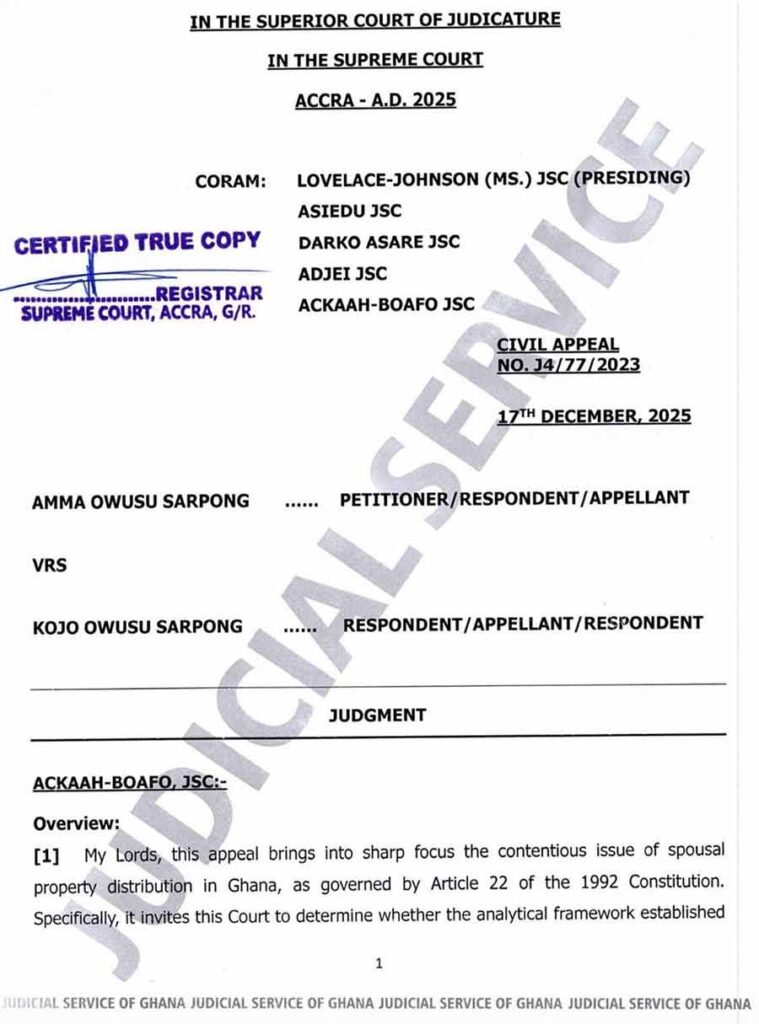
The guidance was outlined by Justice Ackaah-Boafo of the Supreme Court in the case of Sarpong v Sarpong, decided on 17 December 2025. The ruling builds on earlier jurisprudence, including the landmark Adjei v Adjei decision, and is intended to bring greater clarity and consistency to property settlements following the dissolution of marriage.
According to the court, where a trial judge determines to award a specific percentage in the distribution of marital property, the basis for that decision must be clearly articulated. The court identified several factors that should be considered in assessing what constitutes an equitable outcome.
Among the key considerations is the duration of the marriage, assessed in relation to when the disputed property was acquired. The court said judges should also examine ownership of the land on which a property stands, including whether it was solely owned by one spouse prior to the marriage.
The chronology of construction was highlighted as another critical factor, requiring courts to determine whether development of the property began before or during the marriage. Judges are also expected to consider the source of acquisition, including whether the property was financed from pre-existing resources of one spouse or through loans that remain unpaid.
Pre-marital assets brought into the marriage by either spouse, particularly where they significantly contributed to the acquisition or enhancement of the property, must also be taken into account. In addition, the court directed attention to the financial standing of each spouse at the commencement of the marriage, including whether one entered the union with debt that was later resolved through the efforts or management of the other.
Financial contributions made by both parties during the marriage, whether directly towards acquisition or improvement of property, form a central part of the assessment. The court further noted the relevance of any explicit or implicit mutual financial understanding between spouses, such as an agreement to maintain financial equality.
Importantly, the Supreme Court reaffirmed that non-monetary contributions must be given due weight. These include domestic work, child-rearing, and emotional or moral support, which the court described as intangible yet invaluable contributions to marital property acquisition.
Justice Ackaah-Boafo stressed that the guidelines are not intended to restrict judicial discretion but to assist trial courts in reaching fair and just outcomes that reflect the totality of the marital relationship. Once these factors are assessed, the court said, an objective determination can then be made as to whether a 50 per cent share, or a lesser or greater interest, is appropriate in each case.