

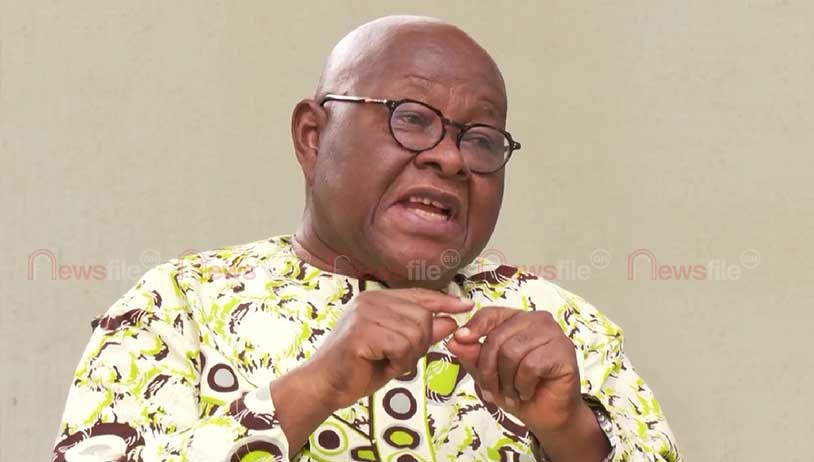
Former Speaker of Parliament and founding member of the New Patriotic Party (NPP), Prof. Mike Oquaye, has described Ghana’s current lithium agreement as “colonial” and warned that repeated pledges to reform the economy and tackle illegal mining will remain hollow unless matched by decisive action.
Speaking in an extended interview, Prof. Oquaye said he was not prepared to pass a definitive judgment on President John Mahama’s government after one year in office, arguing that administrations deserve time to translate words into results. “I will rather wait and see,” he said. “On illegal mining, the government is saying something. A government that has a mandate deserves some time for us to see whether word will match action.”
However, he linked the galamsey fight and Ghana’s economic struggles to what he called fundamentally flawed resource agreements, singling out the lithium deal as emblematic of deeper structural problems. According to Prof. Oquaye, Ghana’s repeated reliance on the International Monetary Fund, now amounting to 17 visits reflects a failure to retain sufficient value from its natural resources.
“If IMF visitation will save this country, wouldn’t you have gone 17 times?” he asked. He argued that the problem transcends partisan politics, noting that governments under different political traditions, including military regimes, have all faced similar constraints. “This is not NPP or NDC. Let us look at the principles,” he said.
At the heart of his criticism is Ghana’s continued dependence on royalty-based mineral agreements. Prof. Oquaye said the global paradigm has shifted from royalties to ownership, yet Ghana continues to accept capped royalty arrangements that deny the state full benefit from assets it already owns. “We must own what we already own. We own the lithium,” he said.
He criticised provisions in the lithium agreement that reportedly cap Ghana’s earnings at between 9 and 13 percent, describing them as indefensible. “Who puts a ceiling on what you can pay him for what belongs to him?” he asked. “It is a colonial arrangement. Long ago, when we were colonised, they owned everything and gave us royalties. Why should we accept that logic today?”
Prof. Oquaye rejected arguments that Ghana lacks capital or expertise to pursue ownership-based models. He said investors do not bring cash “in their bags” but raise financing from capital markets, just as Ghana itself could do. “Afro-capital wants to know if the project is economically feasible. If it is, they will give you the money,” he said.
He also dismissed claims that foreign expertise is indispensable, pointing to Ghanaian engineers already working at the highest levels of the mining industry. “Go to Ashanti Gold today. There is no white man in the engineering area at all,” he said, adding that Ghana should mobilise its own skilled professionals and form local consortia to manage extraction.
Beyond mining, Prof. Oquaye tied resource ownership to broader national development goals, including industrialisation and job creation. He argued that lithium should be processed locally, with Ghana manufacturing batteries and related products rather than exporting raw materials. Such an approach, he said, could power schools, support technology access in rural areas and reduce dependency on imports.
Turning to public commentary praising the lithium agreement, Prof. Oquaye took direct aim at Lands and Natural Resources Minister Armah Kofi Buah, saying there was “no reason” for any official to express satisfaction with the deal. “You cannot be happy with such an arrangement,” he said, warning that price ceilings effectively allow investors to reap unlimited upside while Ghana’s returns remain fixed.
On the broader economy, Prof. Oquaye acknowledged that recent rhetoric from successive leaders from “Ghana Beyond Aid” to renewed calls for value addition and self-reliance, reflects an awareness of the problem. He cited President Mahama’s remarks at the World Economic Forum in Davos, where the president warned against overdependence on outsiders for security, health and development.
Yet Prof. Oquaye said the persistent gap between rhetoric and reality is what continues to undermine public confidence, especially among young people. “The gap between words and action is manifestly awful,” he said. “Unless we change the paradigm, the paradigm that makes us all want to go to Dubai, we will continue borrowing and begging.”
He concluded by urging Ghana to renegotiate its approach to strategic minerals, insisting that ownership, not capped royalties, should form the basis of future agreements. “Let us come to the table and work out the equities,” he said. “The lithium will last only 12 to 15 years. It belongs to Ghana. We must take our equity first, and build our future on it.”