

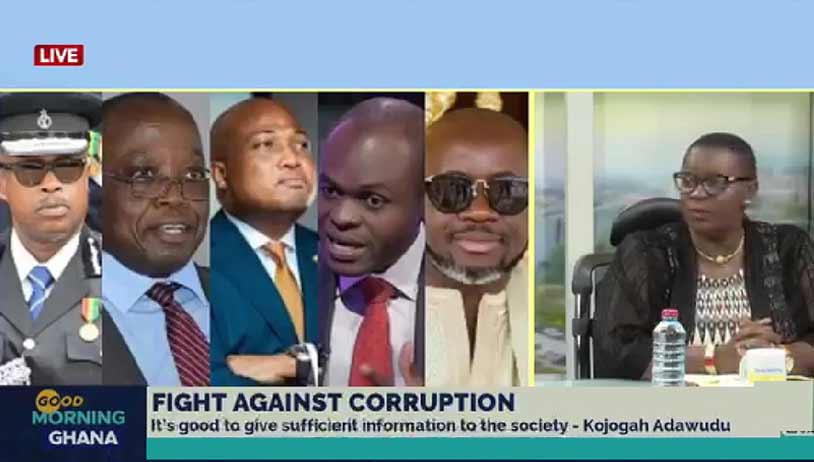
A recent panel discussion on Metro TV’s Good Morning Ghana delved into Ghana’s ongoing fight against corruption, with Ellen Ama Daaku , a member of the NPP communications team providing critical insight into the challenges and dynamics of accountability in public office.
During the session hosted by Moro Awudu, Ama Daaku highlighted the inherent risks faced by individuals who assume public office, noting that officials are always subject to scrutiny once their tenure ends. “When you take public office, you know that one of the risks you run is that after you are done, you could be called upon to account for what you did,” she explained.
Reflecting on the country’s Fourth Republic, Ama Daaku traced the political history of anti-corruption initiatives, particularly highlighting campaigns by opposition parties that promised to recover misappropriated public assets if elected. She cited the efforts led by Hon. Samuel Okudzeto Ablakwa, who campaigned vigorously against perceived financial mismanagement, listing alleged scandals and pledging immediate action upon assuming office.
Following the 2024 elections, the victorious administration formed a Operation Recover all Loot (ORAL) committee to pursue these promises. The team, which included former Auditor-General Domelovo, ex-police commissioner COP (Rtd) Nathan Kofi Boakye, journalist and national Security Specialist, Raymond Archer, and others, were tasked with investigating claims of misappropriated funds and recovering public assets, including land, properties, and bungalows.
Ama Daaku noted that while the committee’s formation fulfilled a campaign promise, it also sparked controversy due to the absence of female representation. “I even had a problem with this team because they didn’t add a woman,” she said, emphasising that women could provide valuable insights in investigations.
The committee’s work attracted significant media attention, with frequent press conferences detailing progress and findings. Ultimately, a substantial report was submitted to the Attorney General for review. However, Ama Daaku observed that the legal and administrative burdens on the Attorney General’s office meant that only a fraction of cases could be addressed immediately. “I knew that they could not even get to 2% of it,” she remarked, noting the challenges of managing inherited cases alongside new investigations.
The panel discussion underscored the complexity of implementing anti-corruption measures in Ghana, highlighting the intersection of politics, media scrutiny, and bureaucratic capacity. Daaku emphasised that while public accountability remains crucial, systemic challenges continue to influence the pace and effectiveness of anti-corruption initiatives.