
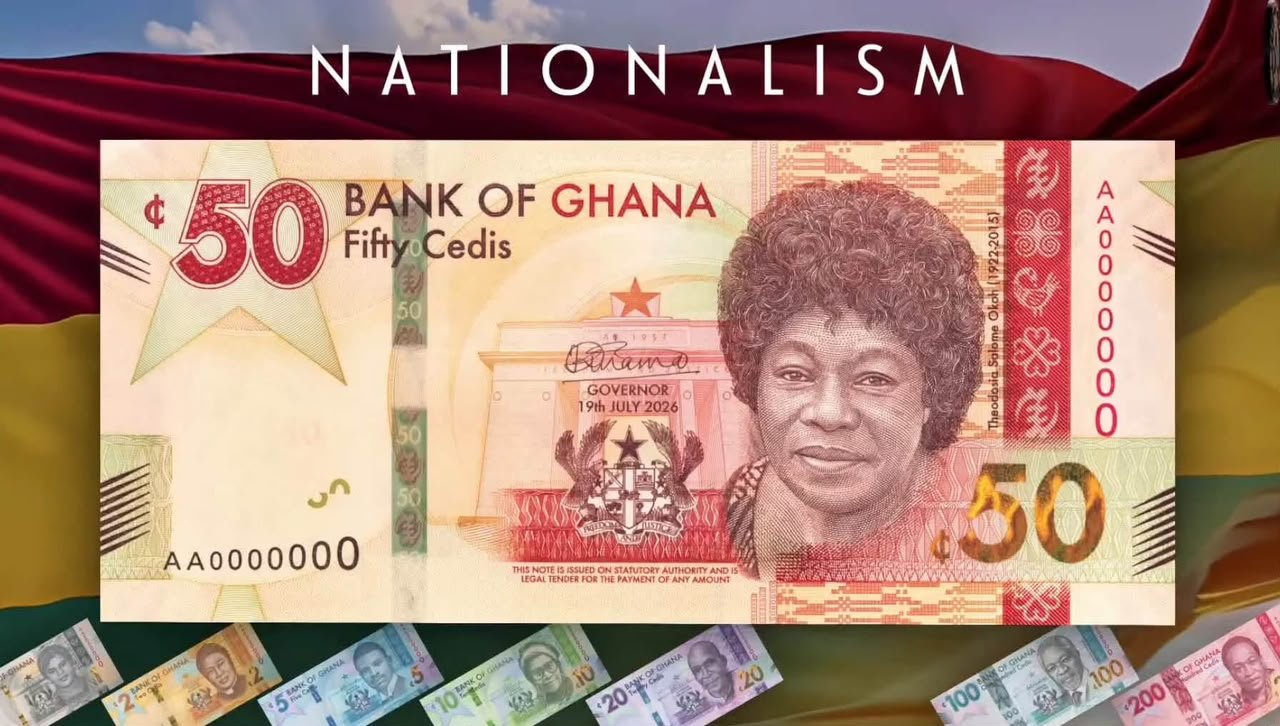
Controversy has rocked the newly unveiled GH₵50 note after claims that the portrait on it is not that of Theodosia Salome Okkoh, the designer of Ghana’s national flag.
The GH₵50 note is part of the Bank of Ghana’s new Heritage Series, unveiled on Thursday, November 12, 2026 by President John Mahama and Bank of Ghana Governor Dr Johnson Asiama at Bank Square in Accra.
The note, the Bank of Ghana explained, is dedicated to Theodosia Okkoh, who designed Ghana’s red, gold and green flag with the black star in 1957, and carries the theme of nationalism.
However, the note was engulfed in controversy soon after its unveiling, with claims that the picture on it is not that of Theodosia Okkoh, but rather her sister.
One of the earliest high-profile public allegations came from Minority Leader Alexander Afenyo-Markin, who spoke at a press conference on Thursday evening, hours after the unveiling.
He accused the government of rushing the redesign of the currency in a bid to erase the Big Six from Ghana’s history, and said that haste had led to a serious error on the GH₵50 note.
“In fact, they were in haste to erase the Big Six from our currency and our history. Out of that haste and hate, we saw them adorning a new GH¢50 note bearing the name of Theodosia Okoh, but they got her picture wrong and placed on the GH₵50 note a different face,” he said.
He argued that the alleged error reflected broader carelessness in the handling of national symbols and public policy.
His comments immediately ignited debate on social media, with many Ghanaians comparing the portrait on the note to known photographs of Theodosia Okkoh.
Eddie Obeng’s corroboration
Hours later, the allegation gained powerful corroboration from a member of Okoh’s own family.
Dr Eddie Obeng, the nephew of Theodosia Okoh and son of Dr Letitia Obeng, posted on LinkedIn that he had woken up proud to hear his aunt had been honoured – only to realise the face on the note was not hers.
Accompanied by front and back images of the new GH₵50 note, he wrote: “I have a wry smile on my face that won’t go away, and occasionally I shake my head or giggle.
“So, I heard this morning that my aunt had been honoured in a new series of issued banknotes in Ghana – she’s famous there for designing the country’s flag after independence from Britain.
“I was very proud and began composing a message to my cousin. Imagine my surprise when I took a look and realised that they have used a picture of my mother instead – she’s famous for being the country’s first lady PhD. You can’t make it up.”
He indicated that the image on the note is his mother Dr Letitia Obeng – Ghana’s first female scientist and first woman to earn a PhD in the country, and the sister of Theodosia Okoh.
On social media, many Ghanaians have used Obeng’s post as the strongest backing for the Minority Leader’s claim, because he is not a political opponent but a family member who, many users say, is better placed to recognise his own mother.
The post has since gone viral, with many commentators arguing that it undercuts any suggestion that the portrait is simply a stylised image of Theodosia Okkoh, as claimed by a director of the Bank of Ghana and Presidential Staffer Beatrice Annan.
Following the uproar, a clarification attributed to Beatrice Annan has been circulating on social media.
According to that clarification, the portrait is an engraved artistic impression of Theodosia Okoh, created by merging three photographs of her, with her hairstyle adjusted to suit engraving.
“The Bank of Ghana has noted discussions on social media about the portrait of Mrs Theodosia Salome Okoh, designer of Ghana’s national flag, on the new GH₵50 Heritage Series banknote,” Beatrice Annan wrote on her Facebook page on Thursday night.
She continued: “A banknote portrait is not an ordinary photograph. It is an engraved artistic rendering created to meet the strict technical requirements of banknote printing.
“It must be sharp, well lit and rich in fine detail so that it can be engraved, reproduced in raised print and incorporate the security features that protect the note against counterfeiting.
“The Bank worked from three authentic photographs of Mrs Okoh, two from her younger years and one from later life. These were used to create a single portrait presenting her as a mature woman while retaining a faithful family resemblance.
“Her hairstyle was also adjusted to align with the family’s style and provide a clear outline suitable for engraving. The aim throughout was to produce a bold, clear and dignified image worthy of her place in our history.
“The result is the portrait featured on the GH₵50 Heritage Series banknote. The Bank is engaging her family to explain the careful work that went into creating the portrait and resolve the issue.”
Several hours after Beatrice Annan posted on her Facebook page, the Bank of Ghana had neither shared anything like the statement on any of its official pages, nor directly responded to the Minority Leader and Eddie Obeng’s claim of a wrong picture of Theodosia Okkoh.
This left many on social media wondering whether the statement Beatrice Annan posted on her personal Facebook page was her personal view or indeed that of the Central Bank.
Many also asked that if the statement was indeed from a sensitive state institution like the Bank of Ghana on such a serious controversy, why was it posted by a director on her personal page, and not the Bank of Ghana’s official communication channel.