
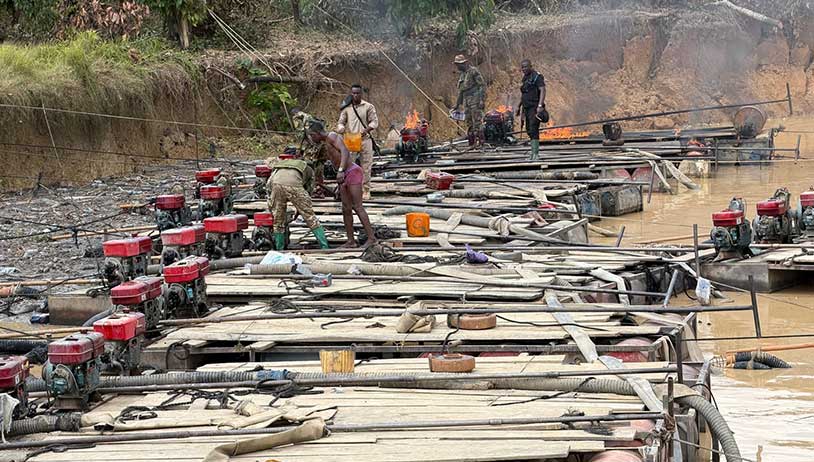
The National Anti-Illegal Mining Operations Secretariat (NAIMOS) has intensified enforcement against illegal mining in the Western and Western North Regions, targeting operations that threaten major roads, river systems, and protected areas.
Between Thursday, November 12 and Saturday, November 14, separate NAIMOS operations along the Tarkwa road corridor and the Bia River led to the arrest of 23 suspected illegal miners and the destruction of 45 chanfang machines and 47 water pumps.
In the Tarkwa-Nsuaem Municipality, NAIMOS conducted two consecutive days of operations from Nsuaem and Simpa through Dompim to Bonsa after identifying illegal mining activities dangerously close to the road and to surrounding communities.
On 12 November, the Task Force destroyed 15 chanfang machines and 22 water pumps and arrested 10 suspected illegal miners.
The following day, personnel returned and destroyed a further 18 chanfang machines and 25 water pumps, while 13 additional suspects were arrested.
In total, the two-day operation resulted in 23 arrests, 33 chanfang machines destroyed and 47 water pumps taken out of operation.
NAIMOS has expressed concern about the growing movement of illegal mining activities into roadsides, farms, plantations and other areas near public infrastructure, warning that such activities pose risks to road stability, motorists, nearby communities and local livelihoods.
On 14 November, a NAIMOS Task Force conducted riverine patrols along the Bia River between Kwasikrom and Awukukron in the Suaman District of the Western North Region, as part of efforts to protect the river, the Krokosue Forest Reserve and the adjoining Bia Game Production Reserve.
Although no active mining was observed during the patrol, personnel discovered 12 chanfang machines deliberately concealed beneath steel platforms installed by illegal miners on the river.
The machines were destroyed to prevent their reuse.
The discovery points to an emerging tactic in which illegal miners temporarily abandon sites and hide machinery in the hope of returning after security personnel withdraw.
NAIMOS has warned that such tactics will not shield illegal operators from enforcement action.
Previously cleared sites will continue to be revisited, while riverine, reconnaissance and intelligence-led patrols will be maintained to prevent reoccupation and the recovery of concealed equipment.
The latest operations demonstrate NAIMOS’ broader approach to extending enforcement beyond traditional mining sites to roadsides, farmlands, plantations, forest reserves and strategic water bodies.
The Secretariat has reiterated that roads, rivers, forest reserves and other environmentally sensitive or critical public areas remain off-limits to illegal mining.
NAIMOS has therefore made it clear that relocating illegal mining activities from rivers to roadsides, concealing machinery, or temporarily abandoning sites will not provide sanctuary.
Where illegal mining threatens Ghana’s water bodies, forests, communities, livelihoods or public infrastructure, NAIMOS will continue to act decisively and sustain pressure until illegal operations are dismantled.