

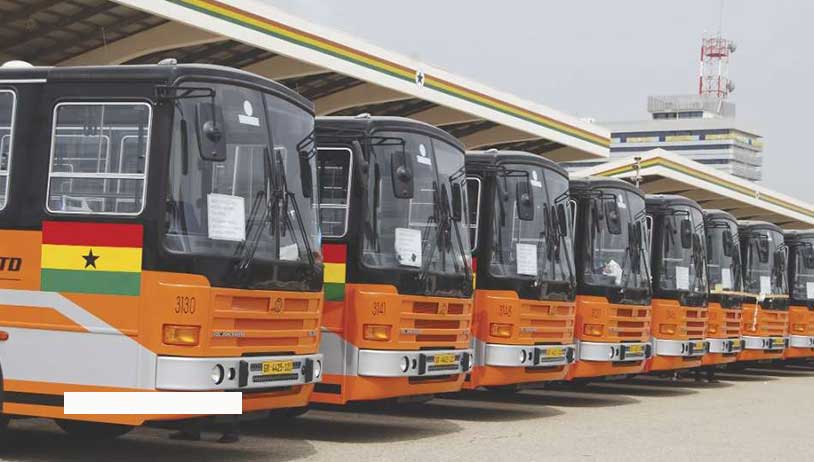
Fresh allegations of large-scale collusion and asset stripping have emerged at Metro Mass Transport Limited (MMTL), with the company’s deputy managing director claiming that buses valued at more than GH₵38,000 were auctioned for as little as GH₵3,000 under the previous administration.
Haroun Apaw Wiredu, the deputy managing director of the state-owned transport operator, said documents have been forwarded to the Economic and Organised Crime Office (EOCO) following what he described as a “grand collusion” in the disposal of the company’s fleet.
Speaking during a media engagement, Wiredu alleged that several buses were deliberately undervalued and sold as scrap, sometimes in bulk, to a single buyer. In some cases, he said, four or more buses were sold to one individual under a single auction receipt, masking the true per-unit price.
“If you look at the face of the receipts, you may think the amount reflects one bus,” Wiredu said. “But when you break it down, you realise the figure must be divided by four or five. That is how buses ended up being sold for as low as GH₵2,300.”
Wiredu cited one example involving a Wangai-branded bus registered in 2015. He said a similar bus, in comparable condition, was sold in October 2024 for GH₵3,000 under the previous management. Last week, however, a valuation conducted by the State Transport Corporation (STC) placed the same model at GH₵38,300, even after key components such as the engine and rear axle had been removed.
“Under normal circumstances, depreciation should have reduced the value,” he said. “Yet less than two years on, the same bus, in worse condition, is valued at more than GH₵38,000. That tells you something clearly went wrong.”
The deputy MD said that between 2018 and 2024, approximately 700 buses were scrapped or auctioned off. About 400 buses were reportedly dismantled and sold as scrap around 2018, while an additional 313 buses were auctioned in October 2024, just weeks before national elections.
According to Wiredu, proceeds from the sale of the 313 buses amounted to about GH₵2.9 million and were paid into an escrow account established during a previous National Democratic Congress (NDC) administration to hold auction revenues. However, he alleged that between January 7 and early March this year, the funds were “heavily dissipated” by the then managing director.
“The explanation given was that the money was used to pay suppliers and salaries,” Wiredu said. “But that was never the purpose for which the escrow account was created.”
He added that the depletion of the fleet had left MMTL at its lowest operational capacity in the company’s history, with some regional depots operating with fewer than 10 buses. In Wa, he said, only six buses were available to serve long-distance routes, forcing passengers to rely on private operators.
Wiredu contrasted the current situation with earlier periods, noting that former President John Agyekum Kufuor handed over about 1,000 buses, while subsequent administrations added to the fleet. By 2017, MMTL reportedly had about 1,100 buses, although only around 600 were operational at the time.
Beyond the auction controversy, Wiredu said the new management has moved to tighten controls and improve revenue collection. He said the “Tap and Go” electronic ticketing system, integrated with the Intelligent Transport Management System (ITMS), has been scaled up from about 45 percent coverage to between 98 and 99 percent nationwide.
The reforms, he said, have significantly reduced revenue leakages. By December, MMTL recorded about GH₵17.5 million in revenue. Automated management of luggage and parcel services has also boosted income, rising from about GH₵500,000 under the previous manual system to GH₵2.7 million in a single month.
“That alone could cover nearly 50 percent of our salary bill if properly managed,” Wiredu said.
He confirmed that the sector minister has ordered the establishment of a committee to review the auction processes, while management prepares a formal referral to EOCO for a full investigation.
“This is public property,” Wiredu said. “We owe it to Ghanaians to ensure accountability and recover value where value has been lost.”
EOCO has yet to comment publicly on the matter, while officials linked to the previous management have not responded to the allegations.