
This image of Anak Krakatoa erupting was taken by Oystein Lund Andersen on Saturday pic: OYSTEIN LUND ANDERSEN[/caption]
At least 62 people have been killed and 584 injured after a tsunami hit the coast on Indonesia’s Sunda Strait, government officials say.
The country’s disaster management agency says hundreds of buildings were damaged by Saturday’s tsunami. It says the possible cause of the tsunami was undersea landslides after the Krakatoa volcano erupted. The strait, between the islands of Java and Sumatra, connects the Java Sea to the Indian Ocean.What is the latest?
The disaster management agency warned that the death toll after the tsunami, that struck at about 21:30 local time (14:30GMT) on Saturday, is likely to rise further. Deaths have been reported in the Pandeglang, South Lampung and Serang regions. Among the areas hit was the popular Tanjung Lesung beach resort in west Java. There was no warning of the advancing wave.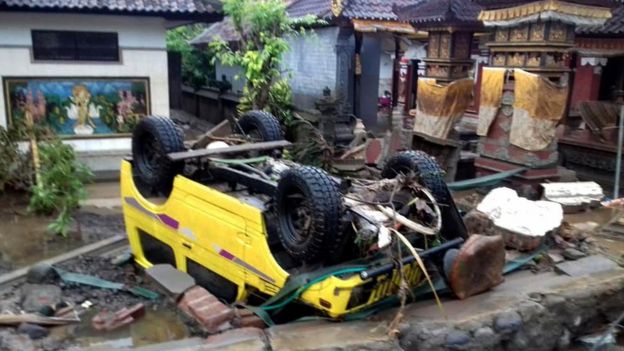 Images released by Indonesia’s disaster management agency showed devastation in Anyer pic: BNPB[/caption]
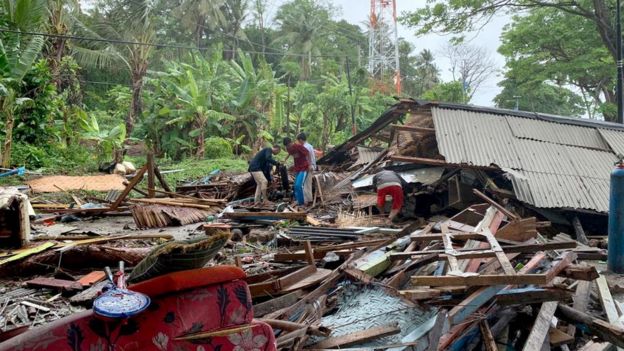 Houses along Anyer Beach were devastated pic:EPA[/caption]
‘There were two waves’
Oystein Lund Andersen, Norwegian volcano photographer, Anyer Beach in West Java I was on the beach. I was alone, my family were sleeping in a room. I was trying to photograph the erupting Krakatoa volcano. Earlier in the evening, there was quite heavy eruption activity. But just prior to the waves hitting the beach, there was no activity at all. It was just dark out there. And suddenly I saw this wave coming, and I had to run. There were two waves. The first wave wasn’t that strong – I could run from it.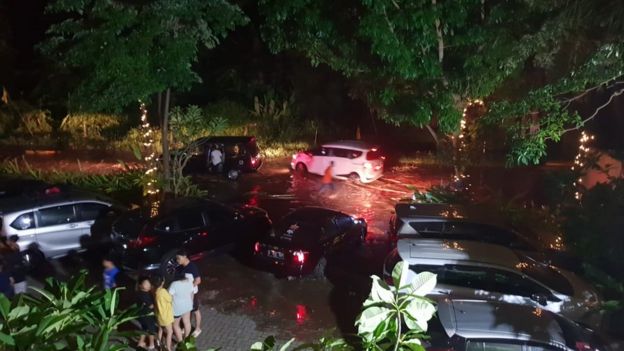 Flooded streets in Anyer after the tsunami pic:OYSTEIN LUND ANDERSEN[/caption]
What might have caused the tsunami?
Emergency officials are investigating whether the tsunami was caused by Anak Krakatoa, a volcanic island in the Sunda Strait. Volcanologist Jess Phoenix told the BBC that when volcanoes erupt, hot magma pushes underground and can displace and break through colder rock. This can trigger a landslide. But because part of Krakatoa is underwater, she said “instead of just causing a landslide, you get an undersea landslide which pushes water as it moves.” This can then cause a tsunami.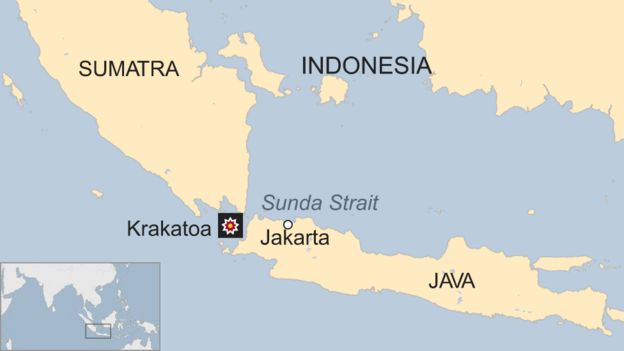
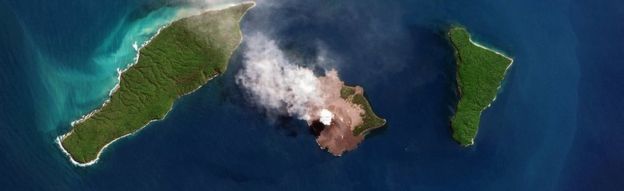 A satellite image of Anak Krakatoa erupting in August pic:GALLO IMAGES/ORBITAL HORIZON/COPERNICUS SENTIN[/caption]
Is this unusual?
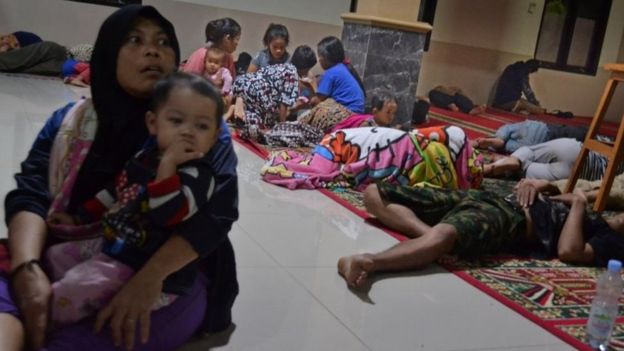 Some residents in the Pandeglang region ran to a local mosque after the tsunami hit pic:REUTERS[/caption]
Krakatoa (Krakatau in Indonesian)
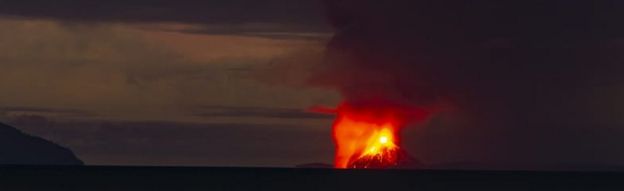 Pic: OYSTEIN LUND ANDERSEN[/caption]
- Massive tsunamis with waves up to 135ft (41m) killed more than 30,000 people
- Thousands more were killed by hot ash
- The eruptions were equivalent to 200 megatons of TNT – about 13,000 times the nuclear yield of the bomb dropped on Hiroshima in 1945
- The eruptions were heard thousands of kilometres away
- World temperatures dropped by more than 1C the following year
- The volcanic island virtually disappeared