
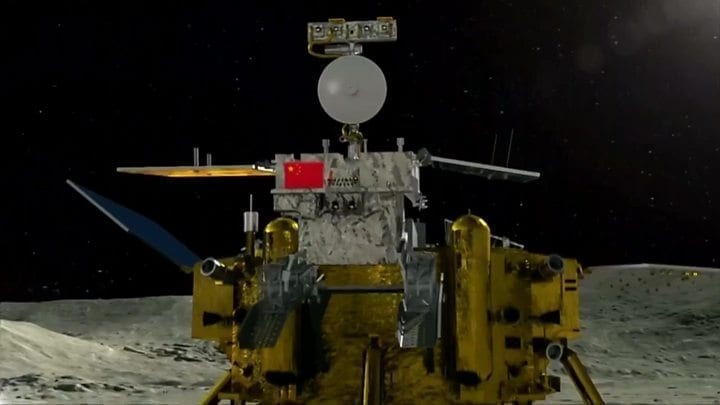
Far side of Moon captured by Chinese spacecraft[/caption]
China says it has successfully landed a robotic spacecraft on the far side of the Moon, the first ever such attempt and landing.
At 10:26 Beijing time (02:26 GMT), the un-crewed Chang’e-4 probe touched down in the South Pole-Aitken Basin, state media said. It is carrying instruments to analyse the unexplored region’s geology, as well to conduct biological experiments. The landing is being seen as a major milestone in space exploration. There have been numerous missions to the Moon in recent years, but the vast majority have been to orbit, fly by or impact. The last crewed landing was Apollo 17 in 1972.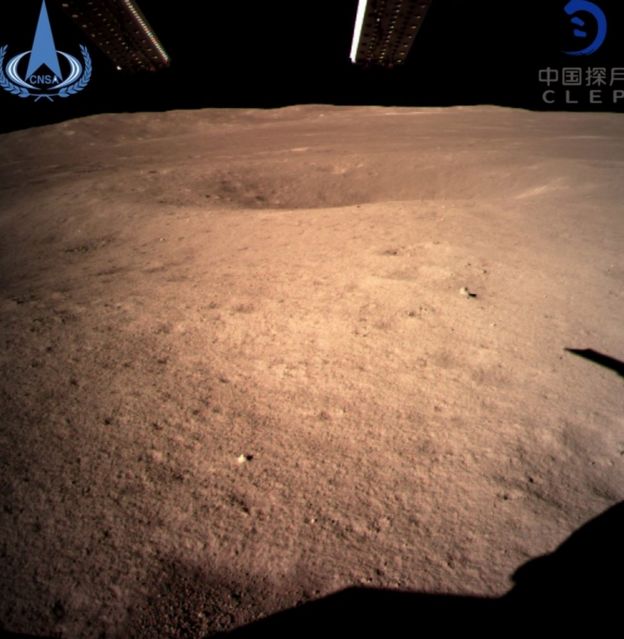 All pictures and data have to be bounced off a separate satellite pic: EPA/CNSA[/caption]
Why is this Moon landing so significant?
Previous Moon missions have landed on the Earth-facing side, but this is the first time any craft has landed on the unexplored and rugged far side. Ye Quanzhi, an astronomer at Caltech, told the BBC this was the first time China had “attempted something that other space powers have not attempted before”.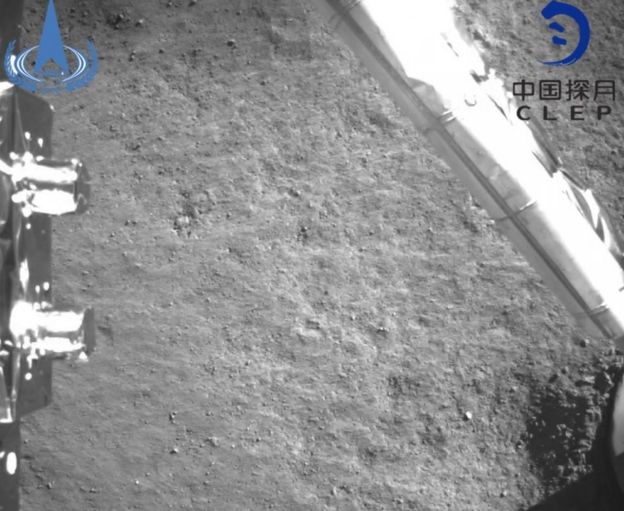 The far side is not visible from the Earth due to “tidal locking” Pic: EPA/CNSA[/caption]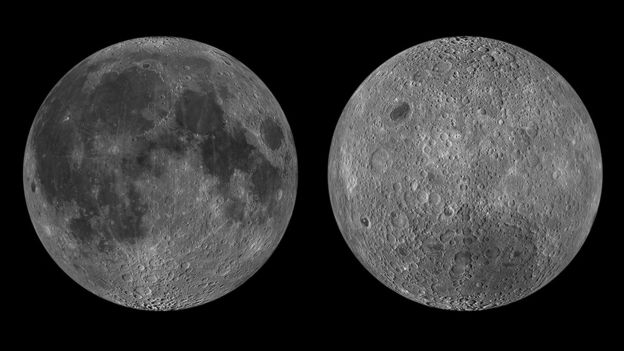
What else might we learn from this mission?
Chang’e-4’s static lander is carrying two cameras; a German-built radiation experiment called LND; and a spectrometer that will perform low-frequency radio astronomy observations. Scientists believe the far side could be an excellent place to perform radio astronomy, because it is shielded from the radio noise of Earth. The spectrometer work will aim to test this idea.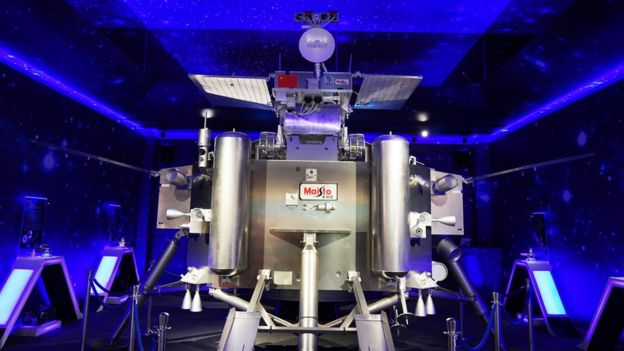 A mock-up of the Chang’e-4 lander and rover, on display in Dongguan, China pic: GETTY IMAGES[/caption]
- A panoramic camera
- A radar to probe beneath the lunar surface
- An imaging spectrometer to identify minerals
- An experiment to examine the interaction of the solar wind (a stream of energised particles from the Sun) with the lunar surface
Is there a ‘dark side of the Moon’?
The lunar far side is often referred to as the “dark side”, though “dark” in this case means “unseen” rather than “lacking light”. In fact, both the near and far sides of the Moon experience daytime and night-time. But because of a phenomenon called “tidal locking”, we see only one face of the Moon from Earth. This is because the Moon takes just as long to rotate on its own axis as it takes to complete one orbit of Earth. The far side has a thicker, older crust that is pocked with more craters. There are also very few of the “mare” – dark basaltic “seas” created by lava flows – that are evident on the near side.How will scientists keep track of the rover?
In an article for the US-based Planetary Society in September, Dr Long Xiao from the China University of Geosciences (Wuhan), said: “The challenge faced by a far side mission is communications. With no view of Earth, there is no way to establish a direct radio link.” So the landers must communicate with Earth using a relay satellite named Queqiao – or Magpie Bridge – launched by China last May. Queqiao orbits 65,000km beyond the Moon, around a Lagrange point – a kind of gravitational parking spot in space where it will remain visible to ground stations in China and other countries such as Argentina.What are China’s plans in space?
China wants to become a leading power in space exploration, alongside the United States and Russia. In 2017 it announced it was planning to send astronauts to the Moon. It will also begin building its own space station next year, with the hope it will be operating by 2022.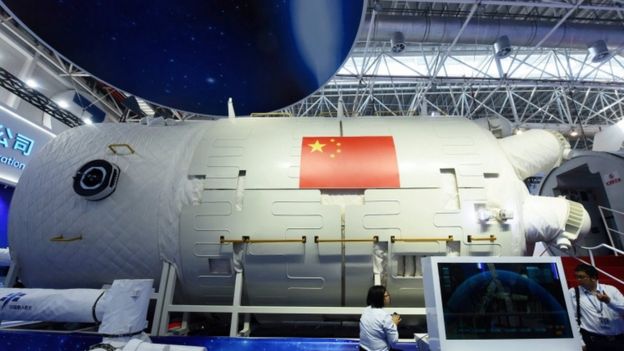 A full-size model of the Tianhe core module of China’s space station pic: REUTERS[/caption]