
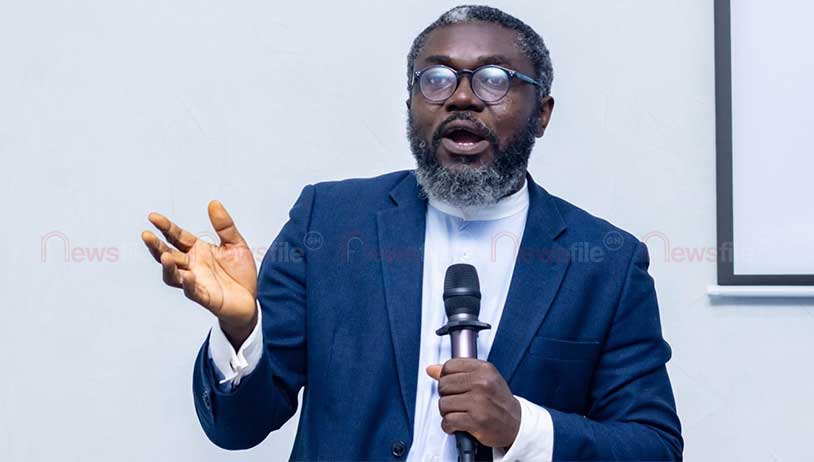
Legal activist Oliver Barker-Vormawor says public debate about Ghana’s political history must prioritise accountability and factual accuracy, as he defended his long-held stance that citizens must scrutinise leaders regardless of ideology or loyalty.
Speaking on Newsfile hosted by Samson Lardy, Barker-Vormawor addressed recent commentary by broadcaster Paul Adom-Otchere concerning Ghana’s first president, Kwame Nkrumah, saying he did not take the remarks personally but viewed them as an opportunity for deeper national reflection.
“I’ve always consistently held the view that whether one supports a government or ideology, you cannot walk away from the responsibility of holding those we elect accountable,” he said. “If someone believes I would apply the same scrutiny in Nkrumah’s time, I take that as a credit.”
The activist acknowledged he responded strongly online to claims about Nkrumah, particularly assertions related to a one-party state and historical symbolism associated with the Convention People’s Party. He said such issues require careful examination rather than “decontextualised” commentary.
Barker-Vormawor noted that his civic group, Democracy Hub, alongside others, has filed a case before the Supreme Court of Ghana seeking constitutional interpretation related to state recognition of figures linked to unconstitutional rule. According to him, the suit asks the court to assess whether state financing or official honours could conflict with the Fourth Republic’s democratic principles.
He said the legal action also examines historical decrees and events surrounding the overthrow of Ghana’s early republican government, arguing that a full understanding requires analysing the political climate of the era, including constitutional developments in 1960 and amendments in 1964.
Barker-Vormawor outlined three major criticisms frequently levelled against Nkrumah: allegations of judicial interference, the establishment of a one-party state and enforcement of security legislation. He argued that these issues are often discussed without sufficient historical nuance, which he said distorts public understanding.
“The idea that Nkrumah made himself president for life is not supported by historical records so far,” he said, contending that constitutional changes in the 1960s in fact expanded parliamentary powers, including the ability to remove a president.
He also defended the ideological context in which one-party systems emerged in post-independence Africa, saying such models reflected global political experimentation at the time, including developments in China. Ghana ultimately chose a different democratic path, he added, and critics are entitled to judge that historical outcome, but he stressed the importance of separating verifiable facts from myth.
The activist further cited early parliamentary arrangements after independence, saying constitutional transitions reshaped legislative mandates and electoral timelines in ways that are often misunderstood. He argued that lawmakers of the period made decisions affecting their own tenure while still subjecting presidential authority to public vote.
While acknowledging that questions remain about aspects of Ghana’s early governance, Barker-Vormawor said national conversations should encourage evidence-based debate rather than rhetorical claims. He warned that historical narratives risk becoming politicised when stripped of archival context or scholarly interpretation.
He added that his goal is not to shield any leader from criticism but to ensure discussions are grounded in documented record. “It’s not about saying there are no questions to be asked,” he said. “It’s about making sure we distinguish facts from fiction.”
The comments come amid renewed public interest in Ghana’s political history and its relevance to modern governance debates, with analysts noting that disputes over historical legacy often mirror contemporary partisan tensions.
Barker-Vormawor said he hopes continued dialogue including court proceedings and academic research will help clarify contested narratives and strengthen democratic accountability.