
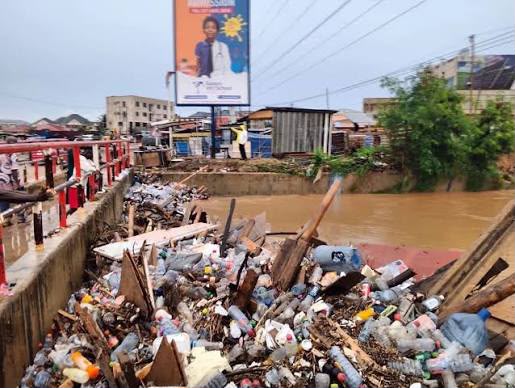
If you live in Accra, you dread the month of June simply because it is the wettest month of the year. This year, however, Accra experienced the worst rainfall in the capital since 1995. According to MyNewsGH, on the night of June 29, 2026, roughly 140 millimetres of rain fell on the city in a single day, destroying lives and property. The media outlet attributes this destruction to human activities. Our society’s shift from natural, sustainable habits to nurtured, unsustainable ones, such as the extreme use of plastics and the disregard for environmental regulations, has disrupted nature’s order. This shift has turned what should be a seasonal blessing into a recurring environmental trap, causing nature to forcefully reclaim its path.
I am neither an engineer nor a meteorologist. I am a food writer with a specialty in indigenous foodways who grew up buying street food wrapped in leaves. Because of this background, I have come to believe that what happens in Accra’s drains every rainy season has a lot to do with what happens on Accra’s plates every single day. This is an opinion piece in which I attempt to make sense of why the water keeps coming back, and why I believe it will continue to return until we change our relationship with the earth that feeds us.
Disregard for Building Regulations
Long before the roads, tall buildings, and roundabouts, streams ran freely from the Akwapim Ridge down through open plains to the sea. Those streams still exist. They have simply been paved over, built on, and boxed in by decades of construction that ignored where water was always destined to go. Engineers and urban planners have stated, plainly, that the city’s building codes forbid construction in wetlands and waterways, but enforcement has been so weak as to be almost decorative. While developers build where they please and the government looks away, the water still travels its natural path into the ocean, destroying all obstacles in its way.
My Personal Memory (The Bowls We Used to Trust)
I remember the “Paris bowl.” Perhaps you do too.
A few years ago, before plastic takeaway containers existed on every corner shop shelf, there was a quiet status symbol in Ghanaian kitchens: a neat, gleaming stack of fancy bowls proudly displayed the moment a visitor walked in. My mother would hand me one, wrapped carefully in a napkin, and send me off to buy her favorite rice balls and peanut soup, waakye, or whatever else she craved. The food came home warm, contained, and dignified. It was carried in something built to be washed, reused, and passed down, rather than thrown away within seconds of use.
Somewhere along the way, we traded these bowls for non-biodegradable Styrofoam packs, plates, and bowls. These are the very items that end up wedged in a drain later, refusing to let the water pass.
The Weight of What We Lose
Behind every flood statistic is a human life gone and the hard work of individuals quietly undone. A trader’s entire stock of tomatoes, smoked fish, and gari, measured out cup by cup for a decade, can vanish in a single night. Goods from warehouses are entirely washed away. A mother returns to a home with no floor left to sweep, and a father discovers that his child’s school uniform, textbooks, and the small envelope of savings kept under the mattress have simply vanished. This is the part of the story that rarely trends: the slow, invisible loss of dignity that comes from starting over again with nothing. Neighborhoods such as Alajo, Kaneshie, and Mallam are hit hard by floods year after year because we do not have a proper drainage system.
I think of my own community in Gomoa-Ewamkrom, and of the women I have watched build their trades one bowl at a time. I think of how devastating it would be to lose in a single night of rain what took a lifetime of early mornings to build. Luckily for the traders in my community, the rains do not flood that part of the country.
Returning to What Already Worked
Here is what I keep coming back to: we already had the answer. It did not need to be imported, patented, or piloted by an NGO. It simply required us to return to our indigenous systems all along.
Imagine walking to the market with a basket instead of collecting a fistful of plastic bags at every stall. Imagine buying your waakye with your own bowl from home, the way it was always meant to be served, rather than in a Styrofoam pack that will outlive your grandchildren in a landfill or a gutter. Imagine eating your fufu or banku from an asanka, the traditional earthenware bowl, instead of a container that leaches microplastics into your soup while it is still hot. Imagine handing the koko seller your own calabash or a reusable cup each morning, instead of adding one more plastic sachet to the pile. Imagine storing your shea butter the way it has been stored for generations, in calabashes and earthen pots.
A culture that packaged its food this way for centuries was not primitive. It was, in ways we are only now rediscovering, sustainable by design.
None of this asks us to invent something new. It asks us to remember something we let go of far too easily, and to be honest about what that convenience has cost us.
Call to Action (Reclaiming Indigenous Sustainability)
If we are to survive changing global climate patterns, we must urgently engage in a collective act of remembrance. We do not need to reinvent the wheel to save our capital. We simply need to stop building in waterways, ban or limit the use of plastics, and revisit our indigenous foodways and architectural wisdom, which were inherently sustainable and respectful of the earth. These indigenous systems represent centuries of intuitive environmental science, being completely biodegradable and naturally integrated into the earth’s lifecycle.
Conclusion
We face floods because we have gone against nature’s ways. And when we do, nature does not simply sigh and move on; it corrects itself, moving through the houses built on its waterways and forcing its way through the drainage systems we have choked with our own waste.
But nature is not our enemy, and it is not punishing us. It is simply doing what it has always done, which is moving toward the sea along paths it never agreed to give up. We are the ones who changed the terms of the relationship.
So perhaps the real question is not “when will the floods stop,” but “when will we start listening again.” Every basket we choose over a plastic bag, every asanka we choose over a Styrofoam pack, every calabash we hand the koko seller instead of adding one more sachet to a drain, these are small acts of peacemaking, not between nations, but between a people and the land that has always fed them. Until we make that peace, the rain will keep finding its old path home, and Accra will keep counting a cost it will never stop paying.
By Hawa Mutawakilu
The author is a food journalist, plant-based chef, and sustainability advocate writing on indigenous Ghanaian foodways, food justice, and peaceful coexistence with the environment. She serves as the Community Engagement and Adoption Lead for Tangelic.
References